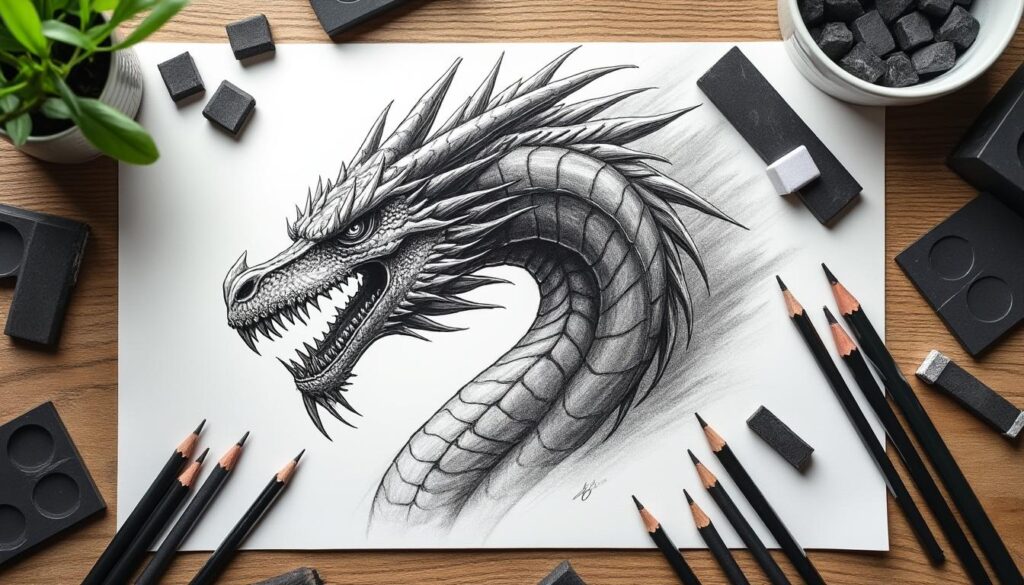
The dragon drawing invites subtle exploration, between the power of a mythical creature and the finesse of a detailed illustration. Each stroke laid down, each curve drawn, tells the story of an imaginary being whose strength reveals itself as much in its posture as in the texture of its scales. Through this fascinating universe, mastering the sketch of this winged giant requires a patient eye and meticulous precision, so that the drawing comes to life with intensity and authenticity. This creative journey combines careful observation and technique, offering everyone the possibility to bring to life this fantasy figure full of unique energy.
Approaching the creation of a dragon drawing is above all accepting the necessary slowness for building an accurate sketch, which combines simple shapes and rich details. The lightness of the gesture in the first strokes allows to establish a stable base, a graphic skeleton where each element finds its place before being refined. By mixing contrasts of shadows and light, the volume becomes tangible, sculpting the scaly skin with all the poetry and rigor that fantasy sketch art demands.
In brief: the keys to a powerful and detailed dragon drawing
- Start with simple shapes: light sketches to set posture and proportions.
- Build with precision: detail the body, tail, wings, and claws integrating natural movement.
- Work on plays of shadow and light: give depth and realism thanks to contrasts.
- Finish with coloring: use a palette suited to the fantasy style to enhance the sketch.
- Take your time: patience is essential for a harmonious and expressive result.
Drawing the foundations of the sketch: laying the dragon’s bases
The drawing often begins with a light, almost invisible outline, sketching the dragon’s general silhouette. This step is comparable to calm breathing, a first setup where simple circles and curves define the position of the head, torso, and tail. It creates a fragile balance between the imposing mass of the body and the airy delicacy of the wings. At this stage, the pencil’s flexibility and the subtlety of the line hint at the dramatic potential of the posture while inviting reflection on the space to be occupied.
In real life, what I often see with children in creative workshops is that this light stage facilitates gaining confidence and frees the imagination. Drawing markers with a fine pencil helps decompose the sketch into accessible elements before developing a more detailed art.
Essential markers to structure the silhouette
To initiate a coherent sketch, placing small circles for the joints, adjusting the spine curve, and drawing the general shape allows respecting proportions. Regularity in this positioning prepares the ground for the future placement of wings or limbs. Precision is not yet there, but the movement is already outlined, ready to express itself through the details that will follow.
Refining the sketch: moving from rough shapes to expressive volumes
As the outlines firm up, the silhouette transforms. The torso broadens, the tail adopts a fluid curve, the claws take shape in a sharp detail. This phase demands patience and a steady hand. The slightly open mouth, lively eyes, and the texture of the nostrils contribute to shaping the dragon’s personality. Each stroke becomes a story.
The care given to these details recalls the precious attentions we put into artistic activities with children, where each mini step reveals a new world. The link between form and expression is fundamental here to capture the very essence of the creature.
Natural decorations: claws, wings, crests
- Claws: emphasize sharpness for an impression of danger.
- Wings: fold the membranes to evoke tension and flexibility.
- Scales: vary the size to suggest relief and depth.
- Expression: capture attitude through the gaze, teeth, and nostrils.
Mastering shadows and lights for a volumetric drawing
Erasing the construction lines opens the way to a new freedom. The dragon takes place in a universe where shading reconstructs the texture and brings relief to life. A delicate play between hatching and gradients relies on careful observation of the light. This technique resembles a silent dance, a graphic dialogue between clarity and darkness that breathes poetry and power into the image.
| Step | Description | Practical advice |
|---|---|---|
| Basic shapes | Draw curves and circles for posture and proportions | Use a fine pencil for light and precise sketches |
| Body construction | Broaden the torso, draw tail, position limbs | Respect proportions and favor supple lines |
| Final details | Add claws, wings, crest, and revealing textures | Work on each element with patience and care |
| Shadows and lights | Apply shades and hatching for volume and depth | Analyze the direction of light and play with intensity |
| Coloring | Add colors suited to the chosen style | Choose a coherent palette and work over light layers |
This final step reveals the entire magical dimension of the dragon, ready to be placed into a fantasy universe where creativity has no limits. It is an invitation for amateurs to continue their practice with accessible and kind tips.
Coloring: enhance with shades and softness
In the colorful palette, each hue tells a story. Whether it evokes blazing flames, ocean depths, or ancient forests, color adds an extra life to the drawing. Our advice: layer light coats to modulate intensity and let the light dance on the scales.
Finally, venturing into this creative project can be done with simple materials: a fine pencil for the first sketch, a softer pencil to highlight outlines, and colored pencils or watercolors for the finishing touch. This simplicity of tools does not limit expression but rather invites a relaxed and joyful approach.
To further enrich your universe, do not hesitate to visit specialized sites offering resources and tips to develop your art, especially to customize your dragon and explore new styles. Enlightened advice to stimulate your creativity can accompany this artistic practice with gentleness.
What equipment is recommended to start a dragon drawing?
A fine pencil for the light sketch, a softer pencil for reinforced outlines, and colored pencils or watercolors for coloring make up an accessible and effective kit.
Must the proposed steps be followed scrupulously?
Following the progression of steps guarantees a balanced sketch and harmonious composition, but you can adapt according to your style and energy of the day.
How to make a dragon more realistic?
Attention to shadows, scale textures, and the dragon’s morphology is essential to bring realism and volume to the drawing.
Can you personalize your dragon?
Each drawing is an opportunity to create a unique dragon by modifying colors, wing shapes, or pose to express the artist’s identity.
How long does it take to master this type of drawing?
Patience and regular practice are the best keys; progress depends on each person, but perseverance makes all the difference.