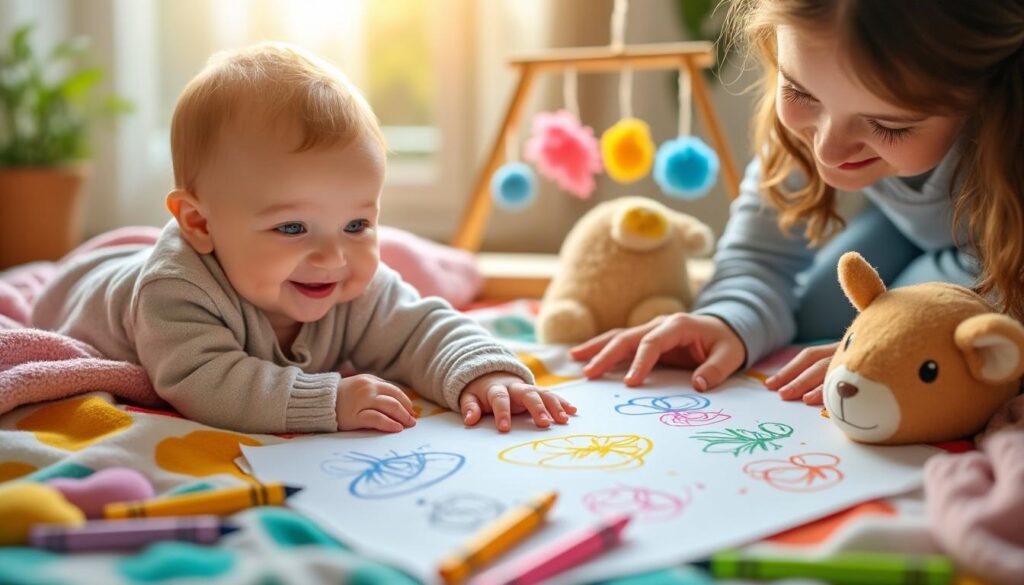
In the first months of life, baby discovers a world rich in colors, shapes, and textures. Offering coloring activities suited to this age is a wonderful way to nurture creativity while stimulating motor and sensory development. From the very first attempts, even if their movements are still clumsy, the baby begins to explore their environment and express their imagination through colors. This artistic awakening lays a solid foundation for fine motor skills, which are essential before learning to write, and fosters self-confidence through freedom of expression. Simple proposals, such as finger painting or collages with various materials, allow for varying textures and sensations, which is crucial for the awakening of little ones. Setting up a dedicated space, where baby can experiment safely while encouraging their first attempts, provides a reassuring framework that unleashes creativity without pressure. Moreover, integrating art into the family routine becomes a playful exploration and a special sharing moment, strengthening the emotional bond while enriching vocabulary and understanding of the visible world. This gentle and respectful approach respects each child’s unique pace, offering concrete ideas accessible to all parents eager to accompany their baby in this beautiful colorful adventure.
- Coloring is a key educational tool to stimulate fine motor skills and imagination, even from a very young age.
- Sensory artistic activities like finger painting or collages promote tactile and visual exploration.
- A safe and suitable environment encourages baby to express themselves freely without fear of mistakes.
- Regular integration of art into the routine also develops confidence and language about emotions and colors.
- Adapting activities according to the day’s energy respects each child’s pace and avoids frustrations.
Why coloring is essential from the first months for baby’s development
Little ones, even without yet mastering precise movements, greatly benefit from coloring activities. Their nervous system is maturing, and handling crayons, brushes, or even fingers in paint helps refine their fine motor skills, indispensable in the longer term for gestures such as writing or buttoning clothes. In real life, what is often observed in creative workshops is that colors particularly attract babies’ attention due to their vividness, which stimulates their concentration. This contact with artistic materials also opens the way to a first form of expression, giving meaning to their gestures and innate curiosity. Of course, it is the quality of this experience, more than the result, that matters to support happy and pressure-free creativity.
Simple activities to awaken sensory creativity
Starting with simple sensory activities encourages baby to appropriate the material. Finger painting is ideal for this: it offers a rich palette of textures and colors, and the baby discovers cause and effect by feeling the material on their skin. One can also offer collages with pieces of tissue paper, felt, or soft fabrics, which stimulates touch and hand-eye coordination. A little trick often used is to create a small “texture book” where each page offers a different material to explore, turning coloring into a tactile adventure. Remember that these moments don’t have to be long; a few minutes often suffice for little ones to marvel and learn.
Creating an environment conducive to creativity for baby
A space dedicated to artistic awakening allows baby to express themselves safely. It is essential that materials are always non-toxic and age-appropriate. A corner in the home, equipped with aprons, sheets, and safe finger paint pots, provides the little one with a reassuring setting for experimentation. Encouragement from parents or caregivers during each artistic gesture strengthens the child’s sense of confidence, valuing their efforts without focusing on the outcome.
Integrating short regular sessions into the day, prepared in 5 minutes flat, helps make art a natural and recurring moment. You can also adapt according to age and energy of the day, alternating between painting, collage, or even modeling with homemade edible modeling dough.
Comparative table of creative activities suited to the first months
| Type of activity | Main benefits | Recommended materials | Ideal duration |
|---|---|---|---|
| Finger painting | Sensory development, fine motor skills, creativity | Non-toxic paints, large sheets, apron | 10-15 minutes |
| Sensory collages | Texture exploration, hand-eye coordination | Colored papers, fabrics, suitable glue | 10 minutes |
| Edible modeling dough | Fine motor skills, tactile discovery | Homemade dough, simple cookie cutters | 15 minutes |
| Texture books | Tactile stimulation, curiosity | Fabrics, bubble wrap, natural leaves | Varies according to interest |
Properly dosing stimulation to respect baby’s pace
In real life, it is common to notice that babies have “high energy” phases where they are eager to explore, then calm moments where stimulation should be gentler. Respecting this alternation is essential for artistic activities to remain a pleasure and not a stress. Always leave the choice to your baby to continue or stop, without forcing. This kindness helps build a positive relationship with creativity. Moreover, the first activities can also be an opportunity to introduce interactions about colors and shapes, by talking during gestures or showing picture books. A good resource for finding suitable ideas is also this selection of creative activities for babies, very suitable to gently stimulate imagination.
List of indicators to best adjust the activity
- Gaze directed towards the activity: attention is a good sign of interest.
- Facial expressions: signs of joy, curiosity, or sometimes discomfort to observe.
- Duration of engagement: no more than a few minutes without forcing.
- Agitation or refusal: respect these signals as requests for a break.
- Frequency: alternate with calm times to allow reflection and rest.
From what age can sensory coloring with baby begin?
From the first months, it is possible to offer hand activities, like finger painting, adapted to the still very fine motor skills and sensory discovery.
What materials to choose for a baby?
It is essential to use non-toxic paints, soft and safe materials, without small elements that could be swallowed, and to adapt each activity to the baby’s age and abilities.
How to encourage the baby without pressure?
Value each attempt without insisting on the result, praise the baby for their exploration, and create a safe environment where they feel free to try and fail.
Can coloring help develop fine motor skills?
Yes, handling crayons, brushes, or modeling dough greatly stimulates fine motor skills, essential for more precise gestures that will come later.
Are there resources to extend these activities?
Specialized websites offer ideas and printables adapted, such as those related to creative hobbies and awakening available on City of Moms.


