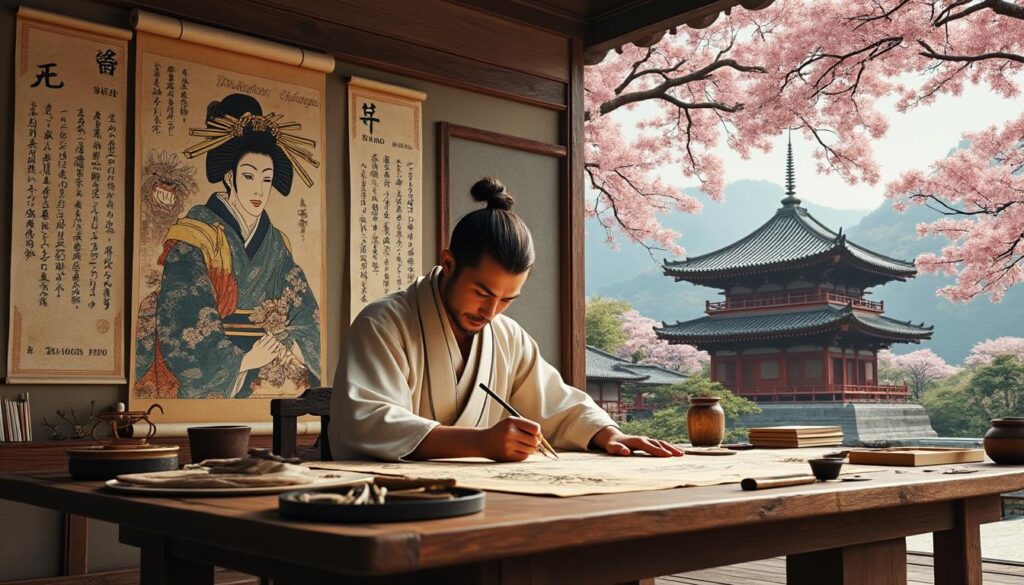
Highly appreciated for their narrative richness and captivating visual universe, mangas have today established themselves as a major facet of Japanese culture. But where do these comics with characters featuring expressive eyes, which captivate both young and old around the world, really come from? Their history takes root in an ancestral narrative art, mixing illustrated scrolls, popular engravings, and modernist evolutions until becoming a remarkable bridge between tradition and modernity. From the Edo period to the great graphic revolutions of the 20th century, this unique visual tale reveals abundant creativity and a rich Asian influence, woven with nuances and deeply human stories.
Following this journey through time, one discovers how these first images narrated on scrolls, called emakimono, form the embryo of contemporary mangas. These stories combining illustration and text were inspired by daily life as well as myths, much like children who use drawing to tell themselves about the world today. The famous series of prints by Katsushika Hokusai, known as Hokusai Manga, marks a turning point by popularizing sketches mixing nature and everyday life as early as 1814, thus giving birth to the very name of this artistic style. This link between image and narration was then nourished by exchanges with the West, particularly after World War II, influencing artists such as Osamu Tezuka, creator of “Astro the little robot,” an emblematic hero during the reconstruction period of post-war Japan.
Also enriched by feminist movements in the 1960s with shōjo manga, or by darker styles such as gekiga, these graphic narratives transcend mere entertainment to address social, political, or emotional themes. Globalization and new digital platforms continue to increase their reach, while raising the question of maintaining artisanal skills, essential to the soul of manga. Today, this Japanese art remains a remarkable testimony to how image and text can unite to tell a story, a true open door to a cultural universe that is both personal and universal.
- Manga draws its roots from 12th-century Japanese narrative scrolls, the emakimono, combining text and illustration.
- Katsushika Hokusai, in the early 19th century, popularized the term “manga” with his sketchbooks.
- After World War II, Osamu Tezuka revolutionized graphic storytelling with heroes like Astro Boy.
- Shōjo manga paved the way for strong female expression from the 1960s onward.
- The gekiga style is distinguished by serious and engaged themes, showcasing manga’s diversity.
- Globalization and digital technology today change the ways mangas are created and read.
The ancestral roots of manga, a visual and narrative heritage
At the heart of the origins of manga lie the emakimono, these illustrated narrative scrolls that appeared as early as the Nara period in the 8th century. These first media told stories by mixing paintings and calligraphed texts and were largely inspired by Chinese graphic arts. Their function was close to that of contemporary comics: telling stories, legends, and scenes from everyday life.
A striking example is the Chōjū-jinbutsu-giga, dating from the 12th century, which features caricatures of anthropomorphic animals in lively scenes, a first step toward the expressive style of mangas. These scrolls established a tradition of visual narration that continues today, linked to the ancestral need of children as well as adults to translate emotions and stories into images.
Artistic evolution and influences up to the Edo period
From the 12th century until the Edo period (1603–1868), popular art evolved with woodblock prints called ukiyo-e. This style, which captures urban life and landscapes, represents an important step toward a more accessible form of graphic art. These colorful prints greatly inspired future mangakas, notably through their composition and ability to narrate multiple scenes within a single image.
Katsushika Hokusai, painter and engraver famous especially for The Great Wave off Kanagawa, is also the author of a series entitled Hokusai Manga, which gathers thousands of large-scale sketches. As early as 1814, he used this term to designate his drawing notebooks, thus giving birth to the modern designation of manga.
The emergence of modern manga: ruptures and influences of the 20th century
The Meiji era (1868–1912) marks a major cultural opening, with a striking mix of Western influences enriching Japanese culture. The development of illustrated magazines favors the appearance of mangakas, who gradually define specific genres, especially after the social upheavals of the post-World War II period.
In this context, Osamu Tezuka revolutionized the scene with a style inspired by cinema and Western comics. His flagship creation, “Astro the little robot” (Astro Boy), is a robot boy with superhuman powers whose innocence symbolizes the reconstruction and hope of a reborn Japan. This hero, become a must-see both in Japan and internationally, contributed to popularizing manga beyond borders.
Genre transformations: shōjo and gekiga
Shōjo manga, aimed at young girls, is also a witness to cultural evolutions. In the 1960s, a group of women, called the Year 24 Group, completely transformed this genre, making it more poetic and emotional. These female mangakas such as Hagio Moto and Riyoko Ikeda paved the way for sensitive and feminine narration, often carried by complex and inspiring heroines.
In contrast to this sometimes light tone, gekiga appeared in the 1950s and 60s as a darker and more realistic style. With engaged authors like Shanpei Shirato or Hiroshi Hirata, it served as a medium for political or social stories, a poignant satire and criticism of the time, marking manga’s maturity as an art form.
| Period | Artistic form | Characteristics and influence |
|---|---|---|
| 12th century | Emakimono (e.g., Chōjū-jinbutsu-giga) | Illustrated scrolls mixing text and image, caricatures of animals, ancestors of manga. |
| Edo period (1603–1868) | Ukiyo-e | Popular woodblock prints with vivid colors and urban scenes, major source of inspiration. |
| Meiji era (1868–1912) | Illustrated magazines | Wide dissemination of illustrations, precursors to serialized stories. |
| 20th century (post-war) | Modern manga | Diversification of genres, Western influence, international expansion. |
From tradition to the contemporary world: manga, globalization, and digital technology
Manga continuously reinvents itself under the influence of globalization. Originally anchored in a strong Japanese identity, it has transformed into a global phenomenon. France, among the first countries to massively adopt this style, has seen its library enriched by more than 15 million copies sold annually, a still lively success despite some recent market fluctuations.
At the same time, the democratization of digital tools profoundly transforms the creation, reading, and distribution of mangas. Webcomics and dedicated apps now allow optimized reading on smartphones and tablets, while offering artists the possibility to reach an international audience. However, this evolution poses the challenge of preserving traditional artisanal techniques, dear to Japanese heritage, which continue to be taught in institutions such as the manga museum in Kyoto.
A list of essential elements illustrating the origins and evolutions of manga
- Emakimono: first narrative scrolls mixing text and illustration from the 12th century.
- Ukiyo-e: colorful woodblock prints from the Edo period.
- Hokusai Manga: pioneering sketchbooks from the 19th century.
- Osamu Tezuka: father of modern manga, with cinematic narration and iconic heroes.
- Shōjo manga: female evolution of the 1960s led by innovative mangakas.
- Gekiga: serious and political style of the 1950s-60s.
- Digitization: webcomics and applications promoting worldwide distribution.
To discover a little more about the narrative and visual richness shaping manga, this video perfectly retraces its key stages.
A highly informative dive into the role of Osamu Tezuka, a true revolutionary of Japanese animation, who marked an entire generation.
To further this curiosity, several legal resources allow you to read mangas from home, facilitating easy access to this fascinating world, notably with platforms Lelscan, MangaPlus, or even other legal alternatives.
What are the first art forms that inspired manga?
The first art forms that inspired manga are the emakimono, illustrated narrative scrolls from the 12th century, as well as ukiyo-e prints from the Edo period. These creations mix text and illustration to tell stories and scenes from everyday life.
What is Osamu Tezuka’s role in the history of manga?
Osamu Tezuka is considered the father of modern manga. He revolutionized graphic narration by drawing inspiration from cinema, creating emblematic characters such as Astro Boy who popularized manga in Japan and abroad.
How did manga evolve after World War II?
After World War II, manga integrated Western influences and diversified into genres, particularly shōnen (for young boys) and shōjo (for young girls), reflecting Japan’s social changes.
What is gekiga in the context of manga?
Gekiga is a style of manga that emerged in the 1950s-60s, characterized by more serious and engaged stories, often political or social, in contrast to lighter and more mainstream mangas.
How does digitization influence manga today?
Digitization has profoundly transformed the creation and reading of mangas, with the emergence of webcomics and mobile applications, making content more accessible and adapted to new consumption modes.