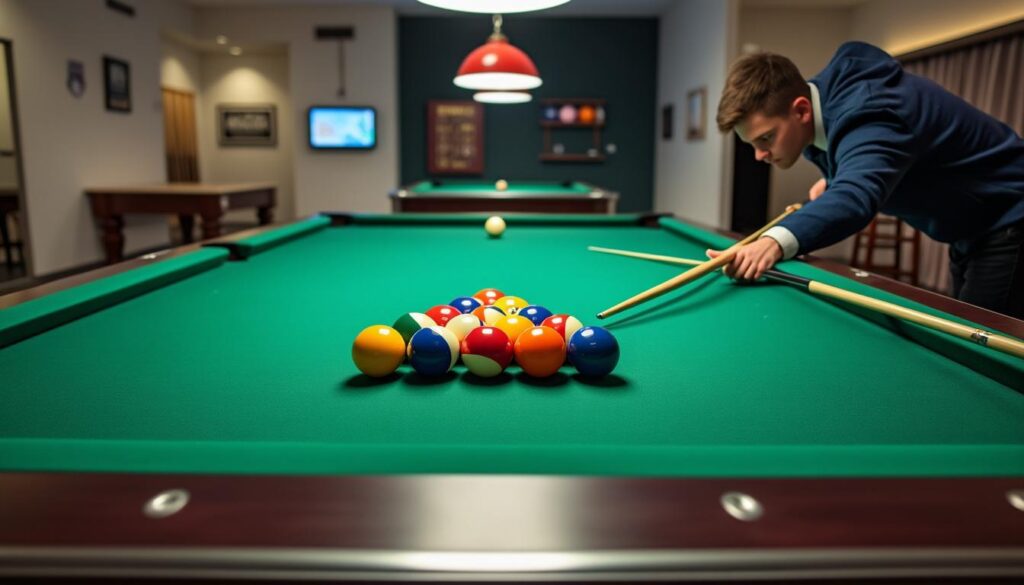
At first glance, lining up the balls seems simple, yet American pool hides a universe rich in strategies and often little-known rules. To fully enjoy this delightful mix of concentration, skill, and tactics at home or with friends, it is essential to understand the fundamentals that govern the game. Which placements to adopt, how to succeed in an effective break shot, which fouls to avoid so as not to penalize your team? These are as many questions whose answers allow the establishment of a favorable framework for progress and shared pleasure. In real life, what one notices is that beginners quickly gain confidence when they know how to organize their game, respect the equipment, and master the main variants such as 8-ball, 9-ball, or 14.1 continuous. Here, the essentials are conveyed gently and clearly to begin your first steps in this friendly game that brings together several generations around the same table.
In brief:
- Respect for the equipment: a well-calibrated table and suitable cues make all the difference.
- Rigorous placement: balls tightly packed in the triangle and specific positioning according to the variant played.
- Strategic break shot: a powerful and controlled break sets the pace of the game.
- Frequent fouls to avoid: pocketing the white, poorly hitting the legal ball, or missing the rail.
- Game varieties: learn 8-ball, 9-ball, and 14.1 with their specific rules to vary the pleasure.
American pool: the basics of equipment and table to get started well
For a beginner, the quality of the equipment plays a decisive role in the fluidity of the game. An official American pool table, with standard dimensions of 2.84 m by 1.42 m, offers a flat and fast surface thanks to its natural slate covered with a wool and nylon cloth. The six pockets are slightly flared to accommodate the balls with a perfect balance between ease and technical challenge. It is in this environment that the cues, generally long between 145 and 150 cm and made of maple or walnut wood, allow a natural grip, attached to shot precision. The tip, leather, chalked before each shot to optimize contact with the white ball, thus avoiding common mistakes such as miscues. A small tool called a rake also facilitates the execution of difficult shots by providing stability and control.
The triangle: a precious ally for perfect ball placement
The triangle, or rack, is essential for aligning the balls. Precise placement maximizes the efficiency of the break. Each ball must touch, especially in variants such as 8-ball where the black ball holds a central place at the heart of the triangle. A tight formation ensures that the force of the break shot propagates uniformly, scattering the balls across the table to multiply pocketing opportunities. This structured framework is a first step toward strategy, where every detail counts.
The essential rules of American pool according to the variants
In American pool, several types of games coexist, each with its subtleties. The most widespread version is 8-ball, where each player chooses between solid balls (1 to 7) or striped (9 to 15), with the ultimate goal of pocketing the black ball after all their balls. An “open” table follows the break as long as the group choice is not fixed. Otherwise, 9-ball offers a fast dynamic where only balls 1 to 9 are in play, with the restrictive rule of always hitting the lowest ball on the table first. 14.1 continuous attracts through a format accumulating points, where each ball is worth a point and where calling shots is mandatory, favoring technical and strategic precision.
| Variant | Number of balls | Ball placement | Main objective | Special rule |
|---|---|---|---|---|
| 8-ball | 15 (plus the white) | Triangle with the 8 ball in the center | Pocket all your balls then the black | Group choice after first legal shot |
| 9-ball | 9 (plus the white) | Diamond with the 9 ball in the center | Pocket the 9 after contacting the lowest ball | No mandatory call |
| 14.1 continuous | 15 (plus the white) | Triangle – free order, 8 in the center | Accumulate points via pocketing | Mandatory call of balls and pockets |
Mastering the break shot: the break
The break shot, often feared, can change the course of a game. It consists of hitting the white ball placed behind the break line aiming at the ball at the head of the triangle. For the break to be valid, the 1 ball must be hit first and at least four balls or at least one must be pocketed or touch a rail. In case of an error, such as pocketing the white or missing the 1 ball, the opposing player gains a significant advantage: the white ball in hand, which they can position wherever they want to maximize their next shots.
A small tip often observed during the creative workshops I lead is to keep your back straight, bend your knees slightly, and ensure a well-horizontal cue to deliver a smooth, fast, and precise shot. Speed in the gesture often prevails over brute force for optimal ball scattering.
Fouls to know to avoid losing unnecessary points
The first discovery for beginners often concerns basic fouls that can change the course of a game. Here are the main fouls to avoid:
- Pocketing the white ball: a serious penalty with ball in hand for the opponent.
- Failing to contact the correct ball: the contact must obligatorily be made with the legal ball determined by the variant.
- No contact with a rail: after contact, at least one ball must touch a rail or be pocketed.
- Ball off the table: replaced on the center spot except the black ball which results in immediate loss.
- Illegal movement: touching a ball with the hands, misusing the cue, or any other object is prohibited.
To simplify, the “ball in hand” rule allows the opponent, after a foul, to place the white ball wherever they wish, guaranteeing a tactical restart. A second practical tip is to avoid rushing, as a series of three consecutive fouls leads to automatic loss of the frame.
Concrete example to avoid losing a game
In a friendly game, a participant pocketed the 8 ball while still having several balls from their group remaining. This rush cost them the victory. This case reminds how patience and mastery of the rules are essential before getting carried away by the excitement of the moment.
Why mastering variants transforms your game in American pool
Each variant gives a particular flavor to your games and stimulates different skills. 8-ball favors overall strategy and group management, the fast and spectacular 9-ball demands great precision in contact, while 14.1 continuous develops method and meticulous anticipation. Knowing these various codes avoids misunderstandings during family games and facilitates harmonious progress.
You can adapt your initiation according to age and daily energy, favoring gentle or more rhythmic games, always ensuring collective understanding and shared pleasure. American pool then reveals a new dimension, far beyond a simple game.
How to place the balls for 8-ball?
The balls are arranged in a triangle with the black ball in the center, the 1 ball at the head, and one corner filled by a solid ball and the other by a striped ball. The other balls are placed randomly but tightly packed.
What does having ‘ball in hand’ after a foul mean?
It allows the opposing player to place the white ball anywhere on the table before playing, providing an important strategic advantage.
Can the white ball be moved if it is touching a rail?
No, the rule prohibits moving the white ball if it touches a rail. The player must then play from this difficult position.
What is the rule about pocketing the black ball in 8-ball?
The black ball must be pocketed only after all the player’s group balls have been pocketed. Pocketing it too early or in the wrong pocket results in immediate loss of the game.
What special rule applies to the break?
The player must hit the head ball first and ensure that at least four balls touch a rail or that a ball is pocketed. Otherwise, the break is considered a foul.