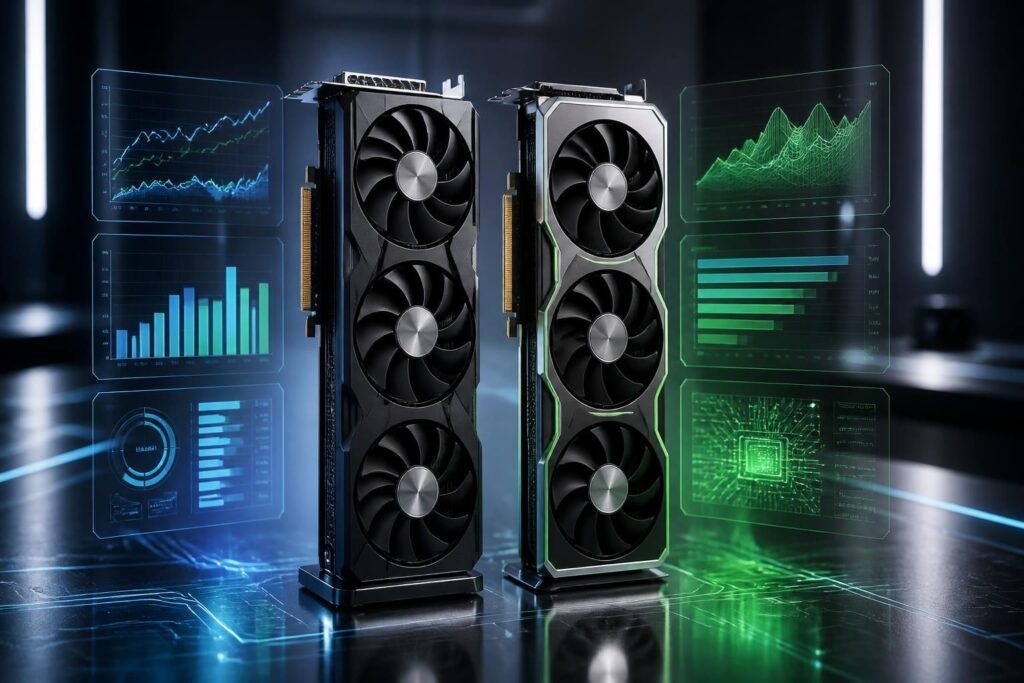
The duel between the NVIDIA RTX 4070 Ti and RTX 5070 stands out as a crucial choice for gaming and graphics enthusiasts in 2026. These two graphics cards operate in similar arenas but reveal notable differences that directly influence the user experience and raw power. The RTX 5070, released in January 2025, offers slightly higher power in several benchmarks, confirming its place in the new generation with a Blackwell 2.0 architecture, which is more recent than the RTX 4070 Ti’s Ada Lovelace architecture. However, the RTX 4070 Ti, available since early 2023, maintains strong vitality thanks to its higher boost frequency and increased number of shading units, ensuring smooth rendering at 1080p and versatility in gaming.
Comparing these GPUs is not limited to numbers but involves understanding how they adapt to our daily usages, whether for intensive gaming or creative work like 3D rendering and modeling. This comparison relies on the latest benchmarks and technical specifications to enlighten families, gamers, or creators today. By evaluating power consumption, memory bandwidth, and performance in standard tests like 3DMark or Blender, it becomes clear that the choice should be guided by one’s needs, priorities, and even sensitivity to electrical consumption.
Comparison of technical specifications and raw power between RTX 4070 Ti and RTX 5070
In the vast forest of graphic technologies, every detail matters for the attentive gamer or creator. The RTX 4070 Ti benefits from a boost frequency of 2610 MHz against 2520 MHz for the RTX 5070, which translates into a higher capacity to handle load spikes. Conversely, regarding memory bandwidth, the RTX 4070 Ti takes an impressive lead with 504.2 GB/s, more than four times that of the RTX 5070 which caps at 120 GB/s. This extended bandwidth facilitates rapid data transfer, essential for complex scenes and detailed textures.
The number of shading units also affects rendering smoothness: the RTX 4070 Ti carries 7680 units compared to 6400 for the RTX 5070. This surplus allows better management of lighting effects and details in 3D environments. Conversely, the RTX 5070 relies on a newer architecture, Blackwell 2.0, promising improvements in energy efficiency and advanced computation management, notably those related to artificial intelligence and noise reduction in images.
Comparing memory and technologies for smooth gaming
More than raw power, memory plays a leading role in optimizing gaming and heavy applications. Both cards use a 192-bit memory bus, but the RTX 4070 Ti dominates thanks to a wider bandwidth, enabling faster rendering of textures and better handling of dynamic scenes. This is particularly noticeable in modern games that heavily utilize AI upscaling features, like DLSS or the recent FSR 3.0 technology. A brief look at a service like the benefits of FSR 3.0 helps better understand how these technologies improve fluidity and visual quality, while requiring a certain level of graphical power.
In terms of connectivity, both display standard compatibility with one HDMI 2.1 port and three DisplayPort 1.4a ports, ensuring installation flexibility on modern setups. This versatility is appreciated by those who want to juggle multiple monitors or enjoy 4K resolution with a high refresh rate.
Performance in numbers: what recent benchmarks say
Synthetic tests reveal nuanced conclusions. The RTX 4070 Ti delivers 40,892 TFLOPS in FP32, about 29% more than the RTX 5070’s 31,615 TFLOPS. This single-precision floating-point calculation will be crucial for graphic processing and parallel computations. However, in some concrete benchmarks, the RTX 5070 shows slightly superior performance. For example, the Vulkan score is 181,073 for the RTX 5070, slightly above the 176,405 points of the RTX 4070 Ti, indicating better optimization in certain tasks.
Another example with Blender: the RTX 4070 Ti beats the RTX 5070 by about 19%, offering faster and smoother 3D rendering, which will delight creators eager for quick modeling. In 3DMark Steel Nomad, the RTX 5070 scores 5300 points, 5% better, indicating balanced performance for gamers seeking precise references.
What are the key advantages to remember when choosing between RTX 4070 Ti and RTX 5070?
- RTX 4070 Ti: Higher boost frequency, superior memory bandwidth, more shading units, ideal for smooth 1080p gaming and fast 3D rendering.
- RTX 5070: More recent architecture (Blackwell 2.0), better energy efficiency, PCIe 5.0 compatibility, slightly better performance on some benchmarks, and advanced AI technologies.
- Both cards support the latest graphical and connectivity technologies, with a subtle balance between raw power and technical innovation.
| Features | RTX 4070 Ti | RTX 5070 |
|---|---|---|
| Release Date | January 2023 | January 2025 |
| Architecture | Ada Lovelace | Blackwell 2.0 |
| Boost Frequency | 2610 MHz | 2520 MHz |
| Memory Bandwidth | 504.2 GB/s | 120.0 GB/s |
| Shading Units | 7680 | 6400 |
| FP32 TFLOPS | 40.892 | 31.615 |
| PCIe | 4.0 x16 | 5.0 x16 |
| Power Connectors | 1x 16-pin | 1x 16-pin |
| Video Ports | 1x HDMI 2.1, 3x DisplayPort 1.4a | 1x HDMI 2.1, 3x DisplayPort 1.4a |
In real life, what I see with children is often that the difference between options lies in trust and adaptation to individual rhythm. It’s somewhat the same in gaming: everything depends on real needs and how each card fits into your environment. A little tip I often use is to carefully look at the requirements of the games you play and the preferred resolution, because these elements naturally guide the choice between raw power and recent innovations.
What to expect in gaming experience with the RTX 4070 Ti and RTX 5070?
At 1080p, both cards offer comfortable and smooth performance for most titles, even the most demanding ones. The RTX 5070 takes a slight edge with about 10% more FPS in recent tests, ideal for demanding players seeking a little extra without changing resolution. But the RTX 4070 Ti is not far behind and remains more than sufficient to fully enjoy AAA games while offering a good margin for creative activities.
Beyond power, energy management and support for AI technologies such as DLSS improvements, FSR 3.0, or XeSS enable a combination of graphic quality and smoothness. On this subject, feel free to explore the benefits of FSR 3.0 for smoother and more efficient gaming, a feat that helps maintain a balance between performance and visual softness even on moderate machines.
Which graphics card is the most recent?
The RTX 5070 was released in January 2025, two years after the RTX 4070 Ti from January 2023, with a more modern Blackwell 2.0 architecture.
Is the RTX 5070 more powerful than the RTX 4070 Ti?
On average, the RTX 5070 offers about 10% more FPS in 1080p gaming and better optimizations for some synthetic benchmarks, despite a slightly lower raw compute power.
What impact does memory bandwidth have on performance?
A wider memory bandwidth, like that of the RTX 4070 Ti, facilitates faster transfers of textures and data, improving rendering in games and memory-intensive applications.
Is PCIe 5.0 an advantage for the RTX 5070?
PCIe 5.0 support offers better scalability and higher potential data transfer rates, although, in current practice, the impact is modest for typical gaming.
How to choose between these two cards according to usage?
For intensive 1080p gaming with fast rendering, the RTX 4070 Ti is an excellent choice. If you’re looking for a newer card, more energy-efficient, with advanced AI technologies, the RTX 5070 will be more suitable.