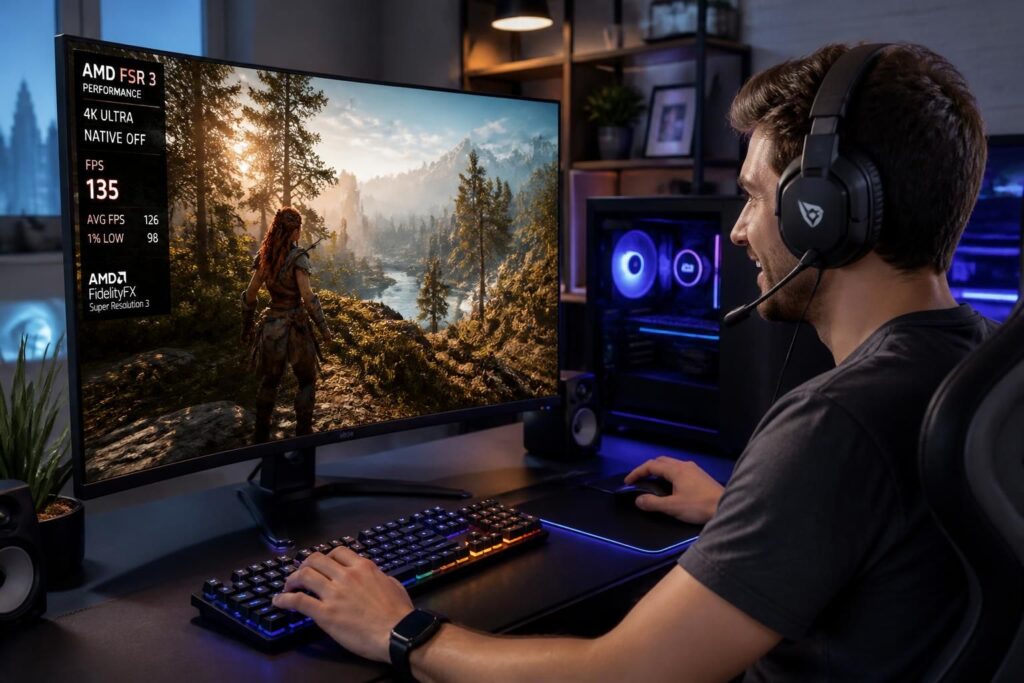
Technological advances in video games continue to evolve to offer players an ever smoother and more immersive experience. Among these innovations, AMD’s FSR 3 technology stands out as a real asset to improve performance while preserving visual quality. This notable evolution goes beyond traditional upscaling by adding frame generation that almost doubles the number of frames per second, thus offering greater fluidity without specialized hardware. In a context where PC configurations vary widely, FSR 3 asserts itself as a universal solution suited both to gamers equipped with the latest graphics cards and to those with more modest systems, including mini PCs and equipment in emerging markets. At the same time, promising prospects open up with the development of FSR 4 and the Redstone project, which further enhance image quality thanks to artificial intelligence.
This adaptability and the constant evolution of AMD technologies benefit a wide audience, whether passionate players seeking to optimize their frames per second (FPS) or content creators wanting to smooth graphic rendering. All this without increasing energy consumption or latency, a crucial point to maintain competitive gameplay. FSR 3, with its flexible approach, embodies a significant step forward in reconciling game performance and aesthetic quality. For families and players on tight budgets, this technology is a key to extending the lifespan of computers and enjoying a quality gaming experience, demonstrating that innovation can also rhyme with accessibility.
FSR 3: an advanced upscaling technology for an optimized gaming experience
The basis of FSR (FidelityFX Super Resolution) rests on a simple but effective principle: first rendering an image at a lower resolution to lighten the GPU load, then reconstructing this image using sophisticated algorithms to reach the final displayed resolution. This method allows increasing the number of frames per second (FPS) while maintaining acceptable image quality, avoiding the significant loss of details often caused by simple image stretching.
FSR 3, the latest generation to date, brings a major innovation with the technique called Fluid Motion Frames. Rather than limiting itself to spatial and temporal upscaling as FSR 2 did, this version inserts between the native frames created by the GPU frames generated by interpolation and motion algorithms. The result is enhanced fluidity, almost doubled in compatible games, without depending on dedicated hardware like specific AI cores. This hardware independence makes FSR 3 fully compatible with AMD, NVIDIA, and Intel GPUs, and thus accessible to a wide range of players. For illustration, a mini PC equipped with an integrated Radeon 890M can thus reach performance of nearly 110 FPS on demanding games at 1080p, whereas without this technology, fluidity would be much lower.
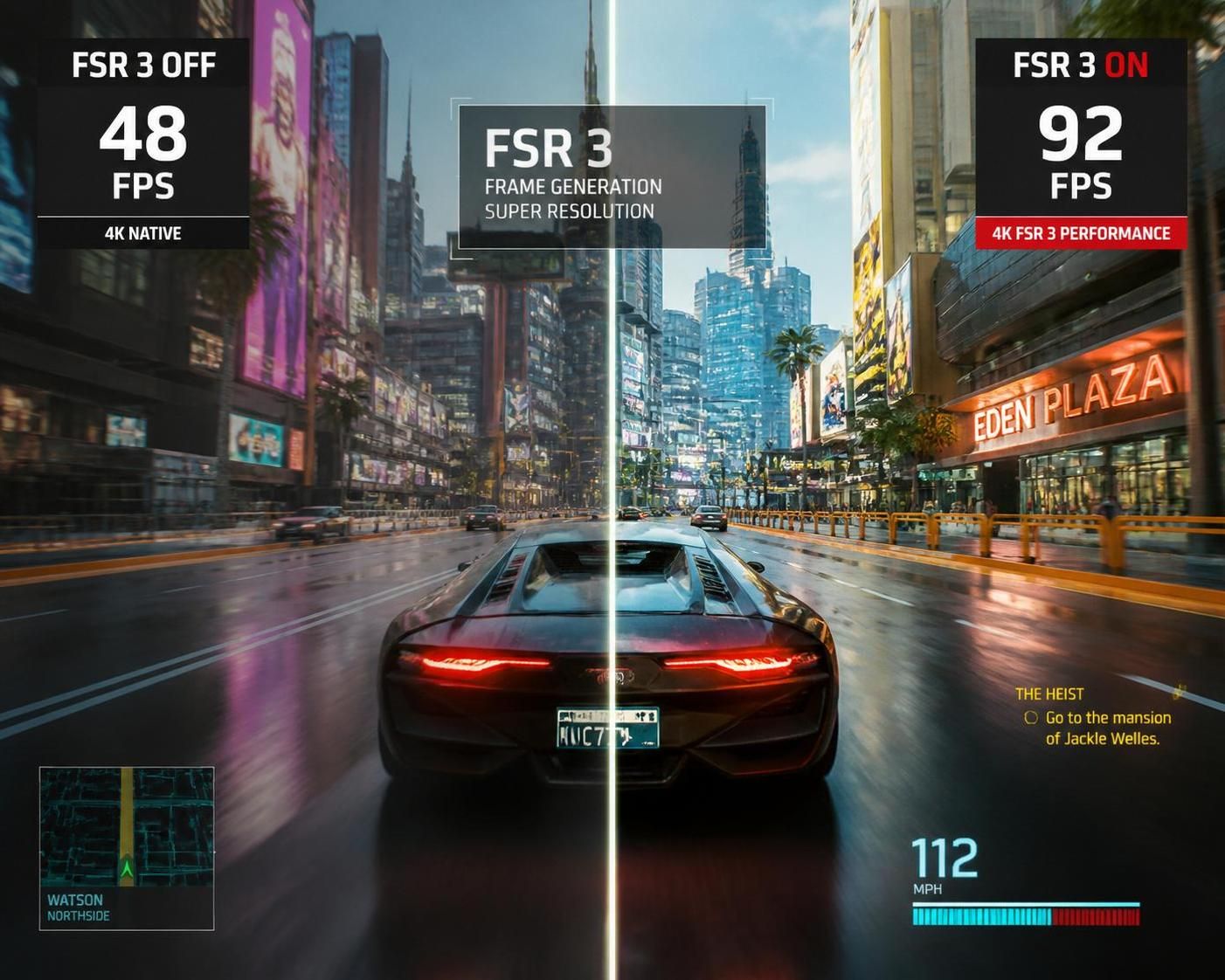
A significant leap in FPS optimization with FSR 3
Fluidity is at the heart of gaming enjoyment. Thanks to FSR 3, perceptible players experience a simplified experience that brings AMD closer to competing technologies like NVIDIA’s DLSS 3, with this ability to generate additional frames. This progress is particularly visible in modern AAA games demanding considerable power. Thanks to this graphical improvement, it becomes possible to comfortably play on equipment with limited capabilities without sacrificing aesthetics.
Latency reduction is also well controlled, as FSR 3 does not use external neural processing requiring additional computation time. This feature guarantees a responsive rendering, an essential factor especially in competitive games where every millisecond counts. For example, during a multiplayer session, increased fluidity and low latency promote precision and gaming pleasure.
FSR 3 in practice: compatibility and benefits for all types of hardware
While some upscaling technologies like DLSS are limited to NVIDIA GPUs equipped with dedicated Tensor cores, FSR 3 stands out for its universality. This open-source solution can be easily integrated into various game engines, notably Unreal Engine and Unity, thanks to its available code and integration via standard shaders. This feature encourages developers to adopt FSR to reach a wider audience without worrying about hardware constraints.
This extended compatibility is all the more valuable in regions where access to powerful equipment is limited. For example, in many areas of Africa where budgets are tight, cybercafés or schools can offer their users an improved gaming and graphical experience without heavy investments. FSR 3 thus extends the lifespan of older or entry-level hardware, making video gaming and 3D creation more accessible.
Configurations benefiting from FSR 3
- Mini PCs and compact computers: often limited by graphics power and thermal capacities.
- Modest gaming PCs: allowing for smoother gameplay without costly component replacements.
- Players with varied graphics cards: AMD Radeon RX 5000/6000/7000, NVIDIA RTX 20/30/40, and Intel Arc.
Evolution of FSR technology: from FSR 2 to FSR 4 and the Redstone project
FSR 3 fits within a steady progression of AMD technologies, which with FSR 4 now fully leverage artificial intelligence to enhance image quality. This fourth generation, exclusive to the RDNA 4 architecture and Radeon RX 9000 cards, uses integrated AI units to reconstruct images with increased fidelity and stability. Visual artifacts are thus reduced, and details close to native rendering gain precision.
At the same time, the Redstone project marks a transition toward a complete graphics acceleration platform based on machine learning. Redstone provides advanced tools for ray tracing, overall rendering optimization, and frame generation taken to another level. These innovations promise an ever greater immersion in complex and realistic environments.
Comparison between FSR 2, FSR 3, and FSR 4
| Characteristic | FSR 2 | FSR 3 | FSR 4 |
|---|---|---|---|
| Type of upscaling | Classic spatial and temporal | Spatial, temporal, and frame generation (Frame Gen) | Integrated AI with dedicated RDNA 4 units |
| Fluidity improvement | Moderate | Significant (up to x2 FPS) | Excellent with fewer artifacts |
| Hardware compatibility | Wide (AMD, NVIDIA, Intel) | Wide with optimization for recent hardware | Limited to RDNA 4 GPUs |
| Image quality | Good | Very good | Optimal, close to native rendering |
| Main use | FPS improvement on varied hardware | Advanced fluidity for modern games | Improved visual quality and stability |
FSR and competition with other upscaling technologies
In the market of graphic enhancement technologies, FSR competes with solutions like NVIDIA’s DLSS and Intel’s XeSS. Each offers specific features depending on usage and hardware. DLSS uses an advanced neural network requiring specific architecture, ensuring often superior image quality, especially in 4K, but at the cost of more limited compatibility. XeSS, more recent, offers a more open alternative, compatible with several GPUs, but still evolving in quality.
FSR stands out for its flexibility and universal accessibility. For players who have an entry-level or mid-range PC, it is a valuable technology allowing significant performance optimization without major compromises in image quality or responsiveness. This feature makes FSR a relevant choice to extend gaming enjoyment, whatever the available equipment.
Does FSR 3 work with all graphics cards?
Yes, FSR 3 is compatible with many GPUs, including AMD, NVIDIA, and Intel, and does not require specialized hardware.
Does FSR technology affect image quality?
FSR primarily improves performance but uses algorithms to maintain satisfactory image quality, avoiding excessive blur.
Is FSR 3 suitable for competitive games?
Absolutely, FSR 3 reduces latency and improves FPS, offering essential fluidity in high-reactivity games.
What hardware benefits most from FSR 4?
FSR 4 requires recent GPUs based on the RDNA 4 architecture, such as the Radeon RX 9000, to fully exploit integrated AI.
Is FSR 3 free and easy to integrate?
Yes, FSR 3 is open-source and can be easily integrated into game engines thanks to its standard shader architecture.


