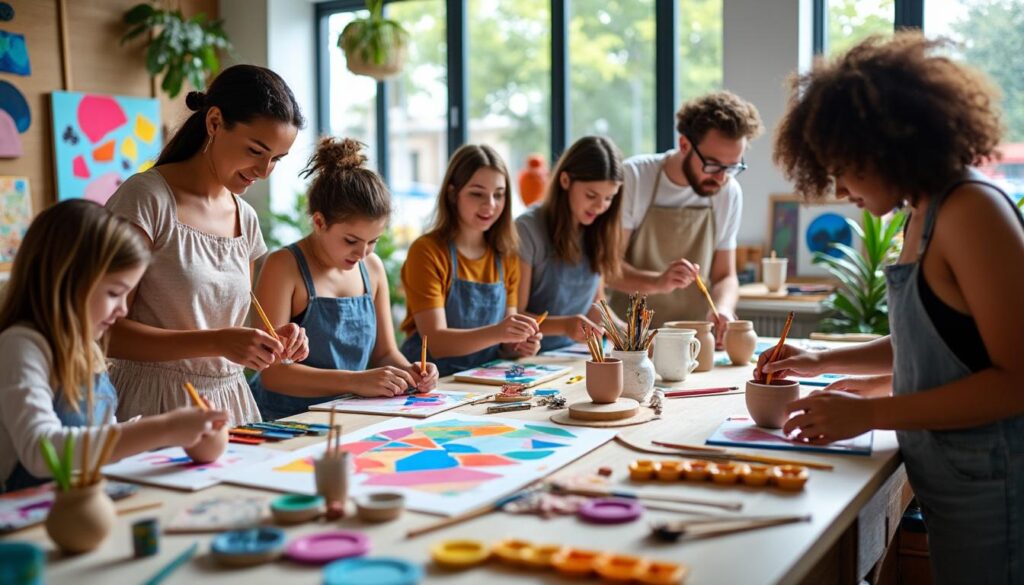
Dominant artistic scene of the early 20th century, Picasso profoundly transformed the perception and practices around artistic creation. His revolutionary art, notably through cubism, challenged conventions by inviting artists and enthusiasts to explore new visual dimensions, thus breaking down barriers in expression and creative leisure. Even today, his influence permeates the creative field, offering families, educators, and art lovers fertile ground to experiment, invent, and stimulate the creativity of the youngest. Between innovative techniques and inspirations drawn from his unique style, Picasso continues to embody a rich and accessible source of artistic inspiration, facilitating the transmission of pleasure and meaning in artistic creation.
In real life, what is often observed during creative workshops with children is that the decomposed shapes and fragmented perspectives of cubism offer an ideal playground for this discovery of the world through the prism of experimentation. In this context, Picasso presents himself not only as a master of modern painting but also as a trailblazer capable of opening paths of artistic freedom, essential to the fulfillment of every child.
This file explores how Picasso, through his aesthetic and technical heritage, continues to revolutionize the daily life of creative leisure, inviting young and old alike to appropriate a process of visual and tactile exploration, far from classical and often constraining models.
Picasso and revolutionary art: a foundation for contemporary creative leisure
Picasso’s work stands out for a constant questioning of aesthetic norms, through the promotion of creativity freed from strict rules. This innovative approach has naturally found resonance in the world of creative leisure, where families and facilitators today seek freer methods to stimulate each person’s artistic potential. Integrating elements of cubism, with its exploded geometric shapes and multiple viewpoints, into children’s workshops is an invitation to discovery and play, without fear of the “wrong” result.
A little trick I often use in my workshops: proposing to children to break down simple objects into geometric shapes, like cubes or triangles, before recomposing them in collage or painting. This method, directly inspired by Picasso, facilitates access to a guided yet liberating creativity. For example, a child who hesitated to draw a face was able to fully express himself by assembling different cut-out shapes, creating a fragmented portrait that was much more expressive and personal.
Work on gaze and perception
Beyond form, the Picassian approach transforms the gaze cast on objects and subjects. By fragmenting the classical vision, Picasso invites us to see differently, to interpret by multiplying perspectives. This double or triple vision, which may seem complex, is actually an incredible lever to encourage children to explore, feel, and tell their own experience of the world. It is a great way to develop skills that are both artistic and emotional.
Workshops based on this idea often reveal children’s ability to invent unprecedented shapes. For example, during a workshop in a shared garden, a group of children sketched trees in a cubist manner, breaking contours and recomposing branches into shaded segments and angles. This work, besides nurturing their imagination, helped them better observe nature and focus differently.
Innovative techniques inherited from Picasso for children’s creative pleasure
The multiple facets of Picasso’s approach – exploration of materials, play with shapes, juxtaposition of bright colors – offer a range of tools that can easily fit into children’s creative activities. His practice of collage, for instance, is a particularly accessible and fun technique, which can be done with little material and lots of imagination.
In a family or school setting, using torn pieces of paper, scraps of fabric, or cut-out images recalls the freedom to experiment inherent to cubism, while promoting fine motor skills and concentration. Here are some practical ideas to prepare in 5 minutes flat to draw inspiration from Picasso:
- Create a cubist portrait by assembling geometric shapes cut out and glued on a sheet.
- Paint a simple object from several angles, then mix the cardboard pieces to recompose a colorful collage.
- Work on layering lines and shadows, varying bright colors and textures.
How to adapt according to the child’s age and daily energy
In organizing workshops inspired by Picasso, the key is to observe the child’s dynamics. Some days, the energy is explosive, inviting broad gestures in painting or free collage. Other moments call for a gentler approach, like a simple drawing or tactile discovery of various materials. Offering modular activities helps respect this rhythm and establishes a lasting atmosphere of trust and enthusiasm.
Once, a very shy child couldn’t express himself through drawing. A little trick: offering him a feather to paint cubist shapes, which changed his whole perception of the activity. This memory reminds us that creative leisure must always remain a space for exploration and not obligation.
Picasso’s lasting influence on contemporary and family creativity
The link between Picasso and modern creative leisure also lies within an intergenerational transmission dynamic. Offering children activities inspired by his art also gives parents, educators, and facilitators the opportunity to reconnect with uninhibited forms of expression, often very far from usual codes. This helps overcome the fear of “not pretty,” cultivating simple, authentic pleasure in creation.
Here is a table summarizing the key contributions of Picasso in connection with creative leisure:
| Artistic dimension | Contribution to creative leisure | Benefit for the child |
|---|---|---|
| Cubism | Multiplication of viewpoints | Stimulates observation and multiple perception |
| Collage techniques | Tactile, playful approach without pressure of result | Develops fine motor skills and creativity |
| Palette of bright colors | Enriches chromatic experimentation | Encourages emotional expression |
| Formal freedom | Spaces of freedom in creation | Strengthens self-confidence and autonomy |
A creative breath in education and parenting
In real life, introducing an artistic approach in the manner of Picasso in the family environment often facilitates rich exchanges between children and parents. This way of creating together, valuing experimentation and mistakes, nurtures complicity and self-esteem. Creative workshops then take on their full meaning: they are caring spaces where every step of the process is a discovery.
The creativity born from this approach goes beyond mere plastic creation: it also infuses play, stories, behaviors, thus offering a complete environment for every child’s fulfillment.
How can Picasso’s cubism be explained to children?
Cubism can be presented as a way of seeing things from several angles at the same time. For example, a face can be seen both frontally and in profile simultaneously, which stimulates imagination and perception.
What simple creative activities are inspired by Picasso?
Collages with geometric shapes, painting with layered planes, and fragmented portraits are accessible and very fun activities suitable for all ages.
Why integrate Picasso into children’s creative leisure?
His revolutionary art opens the door to freedom of expression, inviting one to overcome aesthetic judgment in order to promote the pleasure of creation and self-confidence.
What materials should be used for workshops inspired by Picasso?
Colored paper, scissors, glue, bright paints, and recycled materials allow creating works inspired by cubism easily and inexpensively.


