Choosing a Japanese first name often means being touched by a sound even before knowing its writing: a soft name like Koharu, bright like Asahi, or short like Nagi. For parents seeking rare names, the appeal also lies in the images they evoke — a season, a landscape, a quality — and the place each can take in the child’s life.
The particularity to keep in mind is that a Japanese first name can be written in several ways. The kanji, those characters carrying meaning, influence the interpretation; the same pronunciation does not always correspond to a unique meaning. This selection offers clues and common associations, to be checked according to the chosen writing.
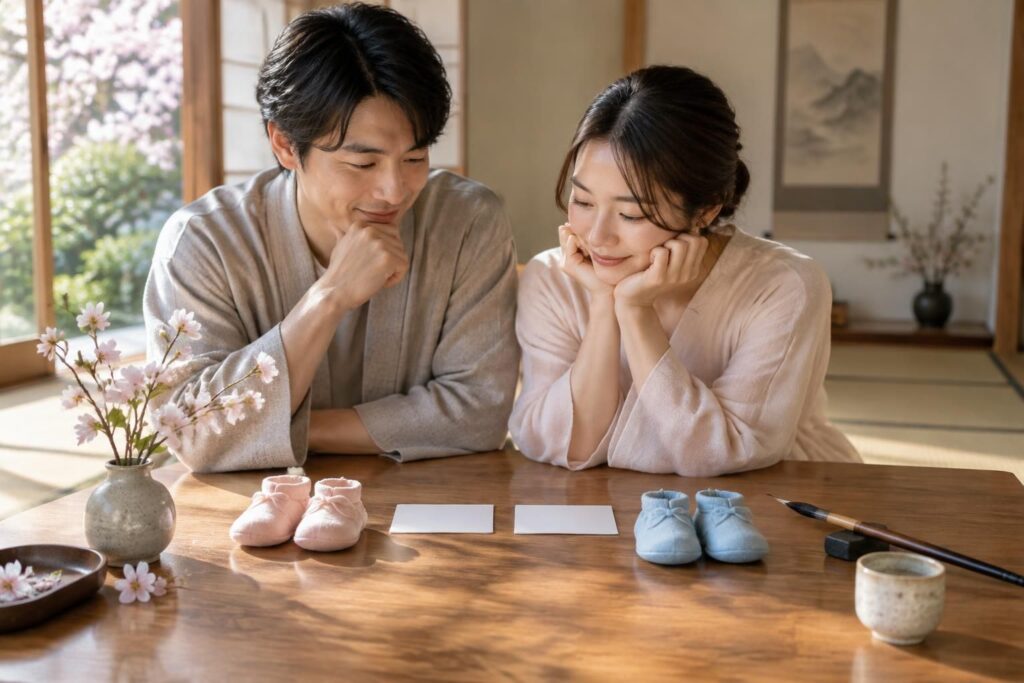
To help imagine, let’s picture Lina and Thomas, who are looking for a name easy to pronounce in French without giving up a Japanese resonance. They can compare the name’s sound, its possible meaning, and its simplicity in everyday life: three concrete guides to bring out a choice that reflects them.
In brief: carefully choosing a rare Japanese first name
- The meaning often depends on the kanji: sound alone is not enough to fix a first name’s meaning.
- Girls and boys: several names can be unisex, and usages evolve according to families and eras.
- Orally: testing the name with the last name helps check its rhythm and pronunciation in French.
- For a first selection: Koharu, Shizuku, Uta, Nagi, Ibuki, and Subaru offer varied sounds and images.
Japanese girl’s name: rare and poetic ideas
To find a Japanese girl’s name, Lina and Thomas start by listening to the sounds aloud. They note those that remain pleasant after several repetitions, then explore possible writings: this approach avoids choosing solely based on an appealing translation.
| Name | Possible evocation | To know |
|---|---|---|
| Koharu | “Little spring” with the writing 小春 | A warm sound, associated with the softness of a season. |
| Shizuku | “Drop” with 雫 | A delicate name that recalls rain or dew. |
| Uta | “Song” with 歌 | Short and easy to pronounce, carries a musical image. |
| Suzune | “Sound of a small bell” with 鈴音 | An association evoking a small clear sound. |
| Tsumugi | Associated with tsumugi fabric, traditionally woven | An original clue linked to Japanese textile know-how. |
These proposals are not universal definitions: the chosen writing can modify the meaning or association. For a rare Japanese girl’s name, it is better to verify the kanji with a person competent in Japanese language, then keep the interpretation that truly corresponds to the family project.
How to distinguish an original Japanese first name from a traditional name?
An original Japanese first name can surprise by its sound, writing, or image, while a traditional Japanese first name fits more into known usages and family or cultural references. These categories are not fixed: popularity changes over time, and a name appreciated in one region or generation may seem less common elsewhere.
A little tip is to write favorites in the Latin alphabet, then ask how they might be pronounced at first glance in French. This simple test sometimes reveals a practical difficulty before it becomes a recurring issue at school or in everyday procedures.
Japanese boy’s name: rare choices with strong sounds
For a Japanese boy’s name, some parents are attracted by images of nature, movement, or light. The options below give clues, but their writing and interpretation must be considered together: the same sound can be associated with different characters.
- Nagi: the kanji 凪 evokes a calm sea when the wind dies down. Its brevity gives it a clear and peaceful sound.
- Ibuki: written 息吹, it can evoke breath or vital impulse. It’s an expressive choice, with a beautiful sound breadth.
- Subaru: 昴 designates the Pleiades star cluster. The name carries a celestial image and a well-known cultural reference in Japan.
- Isana: an ancient form associated with the whale. This uncommon clue may appeal to families sensitive to nature’s words.
- Minato: 湊 can designate a port or a place where boats gather. The name evokes a meeting point and openness.
In real life, ease of use also matters: Lina and Thomas pronounce each option with their last name, then imagine a call in a playground. If the name remains pleasant in several situations, it has already passed a useful test.
Rare Japanese boy’s name: checking meaning and pronunciation
A rare Japanese boy’s name deserves careful verification of its writing, reading, and associations. Characters can carry several nuances; an isolated translation found in a list does not always tell the whole story of the name.
For Francophone families, pronunciation is another practical guide. Reading the name aloud, making it heard by a few close people, and checking that it stands out clearly from the last name helps anticipate hesitations, without turning this choice into an exam.
Meaning of Japanese first names: understanding the role of kanji
The meaning of Japanese first names often depends on the characters chosen. For example, Koharu can be written 小春 and evoke a “little spring,” while Shizuku can be written 雫 and designate a drop; these associations provide markers, but they do not replace verifying the exact writing.
Names can also be written in hiragana, a Japanese syllabary, or sometimes in katakana, often used for foreign-origin words. The choice does not have the same visual effect as kanji: it can emphasize the sound more than an interpretation linked to the characters.
Three useful checks before settling on a Japanese first name idea
- Confirm the writing: ask which readings and meanings are possible for the kanji considered.
- Test the sound: pronounce the name with the last name and in common sentences.
- Consider everyday life: think about how the name will be read and explained in both languages.
This little path helps distinguish an immediate favorite from a choice that accompanies one throughout life. Among ideas for Japanese first names, the best balance is often the one that brings together a story that touches the parents and a form pleasant to wear for the child.
Ideas for Japanese first names: composing a family selection
To avoid getting lost in lists, Lina and Thomas create three columns: “sound,” “image,” and “ease in daily life.” They write down some favorites there, without trying to decide at the first reading; letting the selection rest sometimes allows seeing more clearly what really matters.
The names presented here form a starting point, not an absolute ranking of the rarest names in Japan. Habits vary according to generations and regions, while the impression of originality also depends on the country where the child will grow up.
Frequently asked questions about Japanese first names
Can a Japanese first name have several meanings?
Yes. The same pronunciation can be written with different kanji, whose meanings vary. To know the intended interpretation, it is necessary to check the exact characters associated with the name.
Which Japanese first names can suit a girl?
Koharu, Shizuku, Uta, Suzune, and Tsumugi are clues to explore. Their writing and usage can influence their interpretation; it is therefore useful to check each option case by case.
Which rare Japanese first names to choose for a boy?
Nagi, Ibuki, Subaru, Isana, and Minato offer different sounds and varied evocations. Their degree of rarity, however, depends on local usages and generations.
How to choose an easy-to-wear Japanese first name in French?
Pronounce it with the last name, check the sounds likely to be misread, and think about how to present its writing. A name pleasant in the family’s languages can facilitate daily life.