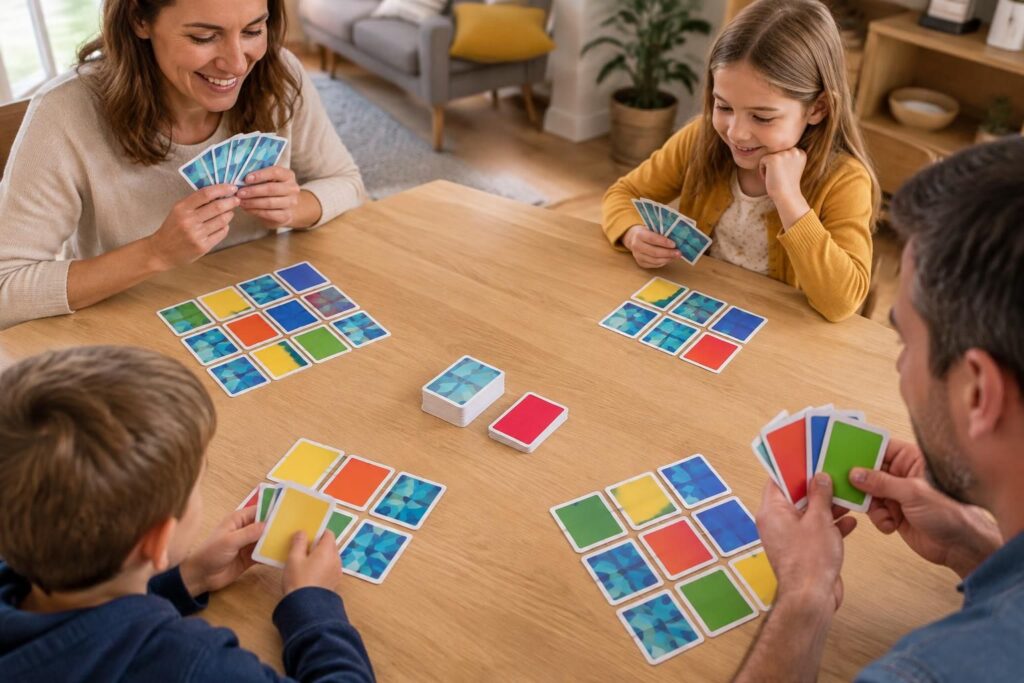
A part of Skyjo often starts with amused hesitation: should you flip a card to see what’s underneath, or keep the mystery a little longer? This family card game is based on a few easy-to-remember rules, but every decision can change the score. In classic mode, players try to reduce the value of their cards and get rid of identical columns. In junior mode, rounds are more accessible to young children, with fewer cards and associations to spot.
To accompany Lina, who’s discovering the game with her parents and older brother, the simplest way is to start with the setup, then follow the game’s progress step by step. The rules are well explained by handling the cards: you draw, exchange, reveal, and observe the others’ choices. Score calculation then becomes an opportunity to count together, without turning the game into an exercise. Here are useful guidelines for playing in classic or junior mode, with some tips to make the first round smoother.
In brief: the Skyjo rules to remember
- Goal of the game: achieve the lowest total score across the rounds.
- Classic mode: each player has 12 cards arranged in 3 rows of 4.
- On your turn: draw a card and swap it, or discard it then reveal a card from your board.
- Identical columns: in classic mode, a column of three cards with the same value is removed from the board.
- Junior mode: the board is smaller and sets of three identical cards help children follow the game.
- End of round: remaining cards are counted, then points add up from one round to another.
Classic Skyjo rule: prepare the cards and start the game
Classic mode is generally played from 2 to 8 players. Shuffle the cards, deal 12 cards face down to each player, then place them in front of you in three rows of four. The remaining cards form the draw pile; flip the first one to start the discard pile.
Each player then flips two cards from their board. The player whose two visible values add up to the highest total starts, according to the usual rule. With Lina, this step quickly becomes a little observation game: she compares the values without yet knowing the rest of her board.
| Element | Classic mode | Junior mode |
|---|---|---|
| Starting board | 12 cards in 3 rows of 4 | 6 cards in 2 rows of 3 |
| Cards revealed at the start | 2 cards | 2 cards, according to the usual game rule |
| Set that allows lightening the board | 3 identical cards in one column | 3 identical cards aligned in one row |
| Objective | Finish with the fewest points possible | Count and reduce the values of your cards |
Different editions and booklets may have slight differences, especially for junior mode: keep the instructions from your box as a reference if a specific rule differs. A clear setup often avoids hesitation during the first round.
Game progress: draw, swap, and reveal
On their turn, a player chooses the visible card from the discard pile or draws a card face down. If they take the discard pile card, they must swap it with a card from their board, visible or hidden, then put the replaced card on the discard pile.
With a card from the draw pile, there are two options: swap it with a card from your board, or discard it. In the second case, the player flips one still-hidden card from their board. This decision provides a small tactical choice each turn: improve a known row or try to discover a more favorable value.
When a player reveals a column of three cards with the same value in classic mode, they remove those three cards from their board and place them on the discard pile. A removed column thus no longer counts toward their total. Lina quickly learns to look at the cards already visible before choosing: a seemingly average card can complete a set and eliminate several points at once.
The round ends when a player has revealed all the remaining cards on their board. The other players get one last turn, then everyone counts their values. This last rotation is important: it gives a chance to make a useful exchange or complete a column before scoring.
Junior mode: adapting Skyjo for younger players
Junior mode uses the same concept of collecting and observing but with a smaller board, often made of 6 cards in two rows of three. The values and illustrations are designed to make sets easier to spot. In this version, three identical cards aligned horizontally can be removed, which lightens the board and makes counting easier.
Children thus discover the game logic without having to manage twelve cards at once. For a first game, an adult can name the steps out loud — “I take, I replace, I reveal” — then let the child choose. The goal is not to play fast, but to make each decision understandable and enjoyable.
The junior rule may vary depending on the edition; so check the booklet provided for the number of cards, end-of-round conditions, and exact scoring. If the child already knows the principle, classic mode naturally follows: the same pleasure of spotting, with more cards to watch.
To further explore family card games, you can also consult the rules of Mille Bornes, another classic where you learn to anticipate others’ cards.
Scoring: counting without mistakes
At the end of the round, each player adds up the value of the cards still present on their board. Cards removed thanks to an identical column are not counted. The results are added to the scores of previous rounds: throughout the game, the lowest total is best.
The player who ends the round must have the lowest score to avoid the penalty provided by the classic rule: if their total is not strictly less than that of the others, their round score is doubled. This rule encourages carefully evaluating your board before revealing the last card. The game ends when a player reaches or exceeds 100 points; the winner is the one who has accumulated the fewest points.
For younger players, note the scores on a sheet and add them up out loud. Lina can thus verify each card one by one, while her brother compares the totals: calculating becomes a step of the game rather than a race to finish.
Skyjo strategy: some useful reflexes at every age
The best strategy depends on the cards already revealed and the situation of the other players. A high visible value is often worth replacing, but a hidden card can sometimes be lower: flipping a card then allows for better decisions. Keeping an eye on the discard pile also helps spot available values and avoid exchanges that bring nothing.
- Watch the columns: two visible identical cards may announce a series to complete.
- Don’t flip blindly: a revealed card provides useful information for following turns.
- Watch the end of the round: if a player has revealed almost everything, adjust your choices rather than keep a very high card.
- Adapt your pace: with a child, take time to compare options before each exchange.
In real life, what children often appreciate is being able to explain their choice: “I keep this one because it can complete my column.” This small verbalization nurtures observation and confidence, without imposing a single way to play. To find general rules for family games, the game rules guide offers other practical references.
To review the steps before dealing the cards, the complete Skyjo rule can also serve as a reminder. Once the first turn is underway, the moves quickly come back and everyone can focus on the joy of playing.
How many cards does each player receive in classic mode?
Each player receives 12 cards, placed face down in three rows of four. Two cards are flipped before the start of the game.
What happens when a column contains three identical cards?
In classic mode, the three cards of the same value aligned in a column are removed from the board and do not count towards the round score.
How does a Skyjo round end?
The round ends when a player has revealed all the cards on their board. The other players then take one last turn, and each sums the values of their remaining cards.
Does junior mode follow exactly the same rules as classic mode?
The general principle is similar, but the board is smaller and the sets are adapted for children. Details may vary depending on the edition; the box booklet remains the reference for scoring and round end.


