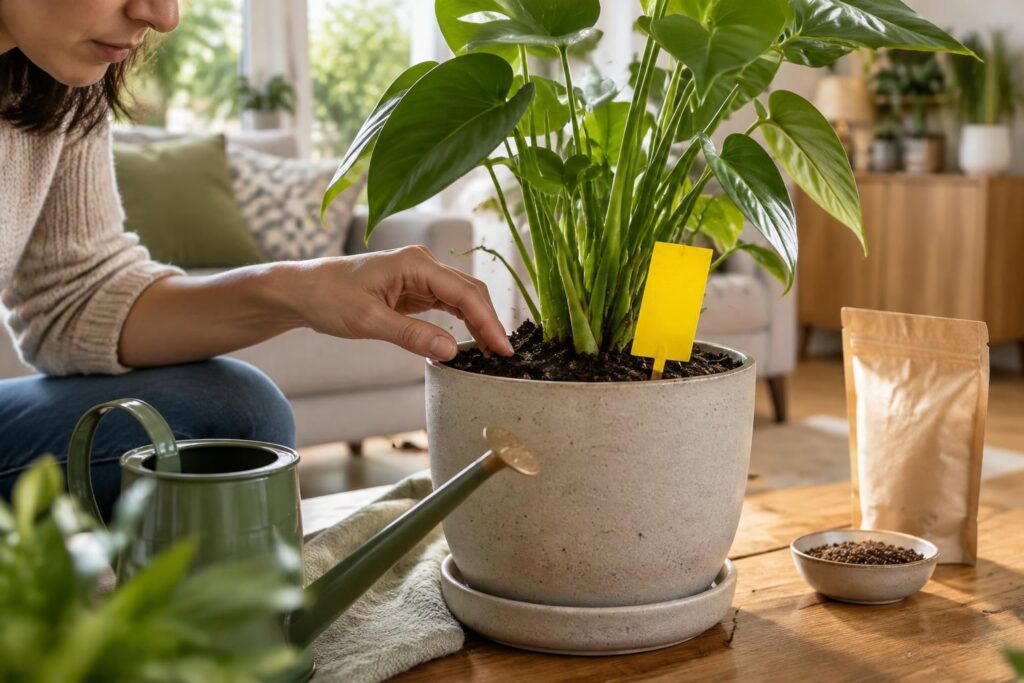
Some small black insects fly around the pot, land on the screen, or appear near a window: plant gnats quickly turn a green corner into a source of annoyance. Their presence often indicates soil that remains too wet for too long. The adults are mainly bothersome, but their larvae, hidden in the substrate, can weaken young shoots when their numbers become significant.
To get rid of gnats permanently, you need to act in two places: reduce the conditions that favor their development and capture the insects already present. A gnat trap helps limit the adults, while adjusting watering and targeted substrate maintenance address the cause. There is no need to upheave the entire house or treat each plant blindly: a few simple actions, adapted to the species and its condition, are often enough to regain control.
In brief
- Let the surface of the substrate dry between waterings, if the plant tolerates it.
- Install yellow traps to capture adults, without considering them a complete treatment.
- Remove plant debris and check that pots drain properly.
- If the infestation persists, target the gnat larvae with a method suitable for indoor plants.
Indoor plant gnat: understanding the origin of the invasion
The small black insects that fly away when you move a pot are often fungus gnats, also called soil flies. They like decomposing organic matter and a moist substrate; females lay their eggs there, then the larvae develop in the top few centimeters of soil.
A few adults do not necessarily mean the plant is in danger. However, a repeated presence, combined with constantly soggy soil, calls for a little check: the larvae can attack fine roots and young seedlings. The duo wet soil and gnats is therefore a useful indicator, but not a reason to panic.
To spot the problem, gently tap the pot or lightly stir the substrate surface. If several insects fly away and the soil stays wet several days after watering, start by checking the drainage and maintenance habits.
Watering indoor plants: the first step to fight gnats
Regular watering does not mean soil is always wet. Before adding water, touch the soil or check its moisture with a finger: some plants like a substrate that dries out on the surface, while others need more freshness. The important thing is to adapt the rhythm to the plant’s needs, the season, and the light.
Empty the saucer after watering and ensure the pot has drainage holes. For plants that can tolerate it, waiting for the top centimeters to dry reduces the substrate’s appeal for egg-laying. This little routine of watering indoor plants also helps prevent root suffocation.
In an apartment, a plant placed in a cool or dim room may take longer to dry. It is better to check before each watering rather than follow a fixed schedule: the right indicator is found in the pot, not on a date.
If the substrate remains soggy despite spaced waterings, check that there is no stagnant water at the bottom of the cachepot. Correcting the moisture is often the most effective step to break the insect cycle.
Getting rid of gnats: traps and natural treatments
A yellow sticky gnat trap, placed near the pot, captures some of the adults and allows monitoring their number. It must be kept out of reach of children and animals and does not replace treatment of larvae in the soil.
To fight gnats, start by removing dead leaves and debris from the surface. You can also replace the top layer of substrate with fresh soil, avoiding damaging the roots. If the infestation is heavy, a full repotting in a clean pot with suitable substrate can be considered.
A natural treatment against gnats first relies on managing moisture and eliminating decomposing matter. In case of heavy infestation, biological control solutions based on nematodes or bacteria targeting larvae can be used according to the manufacturer’s instructions; check their compatibility with the plant and indoor use.
Avoid aggressive homemade mixtures, essential oils, and insecticides applied blindly: they can damage foliage, harm animals, or do nothing to the larvae. A targeted and repeated action is more useful than a spectacular but ill-adapted treatment.
Preventing gnats in plants: good daily habits
To prevent gnats in plants, inspect new pots before placing them near your other plants. A quality substrate, stored closed and dry, also reduces the risk of introducing insects into the home.
A small weekly routine is enough: remove fallen leaves, check saucers, and observe the surface of the substrate. If a pot suddenly attracts many adults, isolate it temporarily to monitor the evolution without unnecessarily treating the entire collection.
Here is a practical guide to choose the right action depending on the situation:
| What you observe | Recommended action | To remember |
|---|---|---|
| Some adults around a pot | Place a yellow trap and observe | The trap captures adults, not larvae. |
| Substrate surface always wet | Space out waterings if the plant allows | Check the needs specific to each species. |
| Plant debris in the pot | Remove them and clean the saucer | Decomposing matter favors their presence. |
| Persistent infestation despite actions | Examine roots and consider repotting | Choose clean substrate and a well-draining pot. |
In a house where children like to observe plants, this monitoring can become a little detective game: look at the soil, spot leaves to remove, and see if traps fill less. The essential thing is to act regularly, without making maintenance complicated.
Once the substrate is better balanced and adults fewer, keep the same watchful eye for a few days: the gnat cycle does not always stop in one go.
Frequently asked questions about indoor plant gnats
Are indoor plant gnats dangerous to humans?
Fungus gnats are mainly bothersome and generally do not bite people. However, a strong presence can indicate overly wet soil, and larvae can weaken young shoots or fine roots when numerous.
Why do gnats come back after placing a trap?
A yellow trap catches adults but does not eliminate eggs or larvae in the substrate. It is also necessary to correct excessive moisture, remove plant debris, and, if needed, choose a method suitable for larvae.
Should the soil be allowed to dry completely to eliminate gnats?
No, because some plants suffer from complete drying out. Let the surface dry if the species tolerates it, and adapt watering to its needs rather than impose the same rule on all pots.
When should you repot a plant infested with gnats?
Repotting may be necessary if the infestation persists, the substrate remains soggy, or is degraded. Use a clean pot with drainage holes and suitable substrate, handling roots gently.