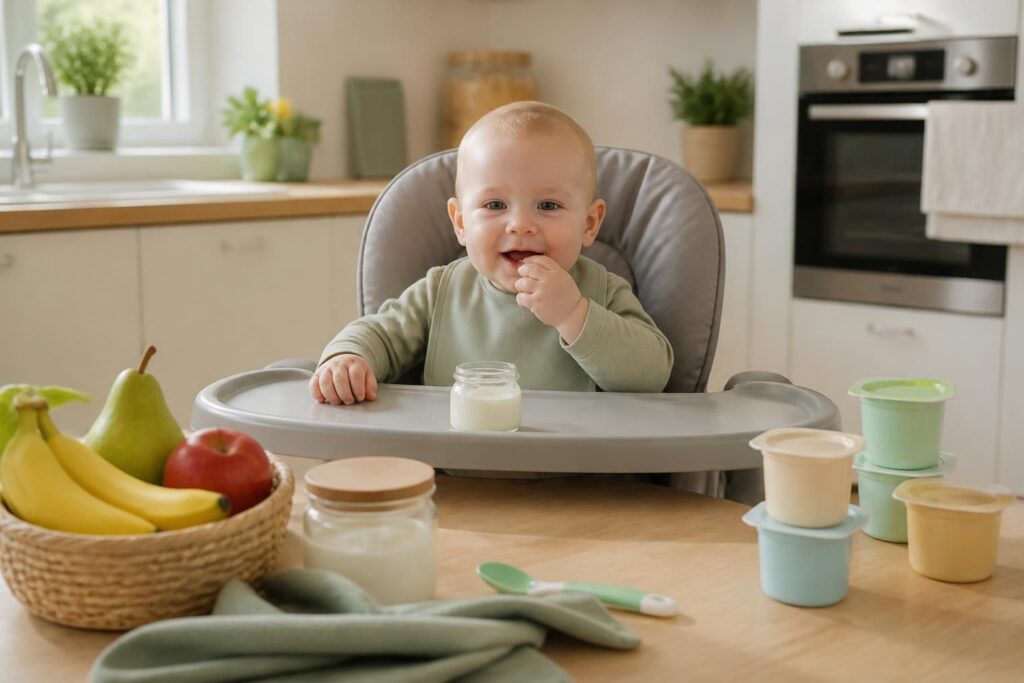
When the little yogurt pot makes its first appearance in the baby feeding adventure, it is often a moment both celebrated and questioned. Yogurt, this gentle and reassuring dairy dessert, raises many questions: at what age is it really suitable? What criteria guide the choice of yogurt brands among the multitude of offers on the shelves? The challenge is not just to choose a product, but to understand your child, their development, and how this stage fits into a varied and balanced diet.
Current infant nutrition recommendations indicate that yogurt introduction can start very early, from 4 to 6 months, but in specific form and quantity. Food safety comes first, and it is essential to favor plain whole milk yogurts, without added sugars or fruits, so as to respect the baby’s natural rhythm. Later, around 10 to 12 months, when the digestive system has matured, the transition to classic yogurts with more variety and choice is considered.
Discover through these lines some concrete guidelines to successfully start yogurt introduction, evaluate the suitable supplies in stores, understand the specificities of baby dairy products, and how to gently support your child in this new taste discovery.
Baby yogurt: starting age for a gentle introduction
As is often the case in real life with little ones, the key lies in the dosage and the chosen timing. Baby yogurt is ideally introduced between 4 and 6 months, within the framework of a cautiously and kindly started complementary feeding. This stage does not replace breast milk or formula, which remains the main food until 1 year, but gently complements the awakening of the palate.
Choosing plain whole milk yogurt is essential to ensure good absorption of essential nutrients, without overloading the still fragile digestive system. In practice, one to two spoons are started with, just to discover the texture and taste, without forcing the issue.
Another point often suggested in the creative workshops I lead: presenting yogurt in a playful way, for example by pairing it with a mild homemade compote to invite the baby to experiment with a mix of flavors, while keeping total control over the sugar.
Why introduce yogurt early despite the potential allergen?
Yogurt contains cow’s milk proteins, a major allergen, which can be worrying. Yet, recent recommendations agree to encourage the introduction of major allergens from the start of complementary feeding. The goal is to gradually train the baby’s immune system to these foods to reduce the risk of allergies in the long term.
This approach is particularly advisable when there is no family history of allergies nearby. In case of doubt, the pediatrician’s opinion remains, of course, the ultimate reference. A small tip seen in daycare centers: always introduce one new food at a time, over several days, and gently monitor reactions.
At what age to switch to classic yogurts?
Later, usually between 10 and 12 months, the digestive system has gained maturity and complementary feeding becomes richer. This is when one can consider offering classic yogurts made from cow’s milk, richer in proteins but sometimes lower in fat, a detail not to be overlooked in the toddler’s nutritional balance.
From this stage, parents are often faced with a wider choice among various yogurt brands. It is then vital to opt for plain products, without added sugars, and to prefer moderate portions: a standard portion of 100 to 125 g per day is sufficient initially, to avoid excessive protein or calcium intake.
In real life, what I observe during workshops is the importance of adapting texture and flavors according to the baby’s appetite and preferences, while remaining attentive to signs of satiety. The goal is not to impose, but to accompany, to open the door without ever rushing.
Key differences between infant yogurts and classic yogurts
The transition from baby yogurt exclusively made with infant milk to classic yogurts is accompanied by a notable nutritional change.
| Type of yogurt | Milk base | Protein content | Fat content | Calcium |
|---|---|---|---|---|
| Infant yogurt | Infant milk or growing-up milk | Adapted | Close to breast milk | Enriched |
| Classic yogurt | Cow’s milk | Higher | Variable, often lower | Not enriched |
These distinctions explain why a gradual introduction of classic yogurts is preferable, to give the baby time to adapt to this new substance and to ensure smooth digestion.
Yogurt brands to favor for baby’s food safety
Amid the bustle of the shelves, some markers reassure parents seeking quality. Baby yogurt brands often offer products meeting strict criteria: no added sugar, no unnecessary additives, organic preferably and packaged in safe containers, often glass to limit plastic.
A little tip I often use in creative workshops: carefully look at the ingredient list — simplicity is key. Avoid yogurts with too strong flavors or complex mixes that may tire the infant’s digestive system.
Moreover, in 2026, several brands committed to a sustainable and ethical approach have enriched their ranges with organic and local variants, thus joining this global wellbeing intention.
- Choose a plain, organic if possible, whole milk yogurt.
- Avoid added sugars, fruits or artificial flavors.
- Favor glass jars or BPA-free packaging.
- Opt for brands with full transparency on composition.
- Consult your pediatrician if you choose plant-based alternatives.
Vegan alternatives: precautions and advice
For some families, plant-based yogurts are an interesting alternative, especially within a vegan diet or in case of cow’s milk allergies. However, not all correspond to the specific needs of infants.
Products based on soy, almond, or coconut must imperatively be enriched with calcium and vitamin D, and validated by a health professional. It is also advisable to vary these alternatives to diversify intakes and avoid deficiencies.
The essential thing remains constant attention, open dialogue with the pediatrician, and vigilance about the composition of the products offered.
Yogurt quantities for baby: simple guidelines according to age
It is very common to wonder how much baby yogurt is reasonable to offer daily. Recommended quantities evolve over the months and the overall feeding mode:
- 6 to 8 months: 50 to 100 g per day of infant yogurt, to complement milk.
- 10 to 12 months: 100 to 125 g per day of classic yogurt, once a day maximum.
- Beyond 18 months: up to two servings per day, totaling about 250 to 300 g of dairy products.
In practice, these guidelines often combine with the baby’s appetite, growth, and tastes. Listening to their signals is always the best way to avoid excesses or deficiencies.
A little tip for parents:
If the child shows less interest one day for yogurt, it is possible to vary with other suitable dairy products, like cottage cheese. You can adapt according to age and daily energy by offering this alternative in 5 minutes flat.
At what age can baby yogurt be started?
Plain whole milk yogurt can be introduced from 4 to 6 months, in small amounts, as a complement to breast milk or formula.
Why wait to give classic yogurts?
The baby’s digestive system needs maturity, generally around 10 to 12 months, to properly tolerate the proteins and calcium from cow’s milk contained in classic yogurts.
How to choose the best baby yogurt brands?
Prioritize plain yogurts, organic if possible, without added sugar, with a simple composition and safe packaging. Consulting the pediatrician for specific choices is recommended.
What vegan alternatives are there for babies?
Vegan alternatives must be specifically designed for babies, enriched with calcium and vitamin D, and validated by a health professional.
What quantities of yogurt should be offered according to age?
From 6 to 8 months, 50 to 100 g/day of infant yogurt; from 10 to 12 months, 100 to 125 g/day of classic yogurt; after 18 months, up to 2 servings per day, about 250 to 300 g of dairy products.