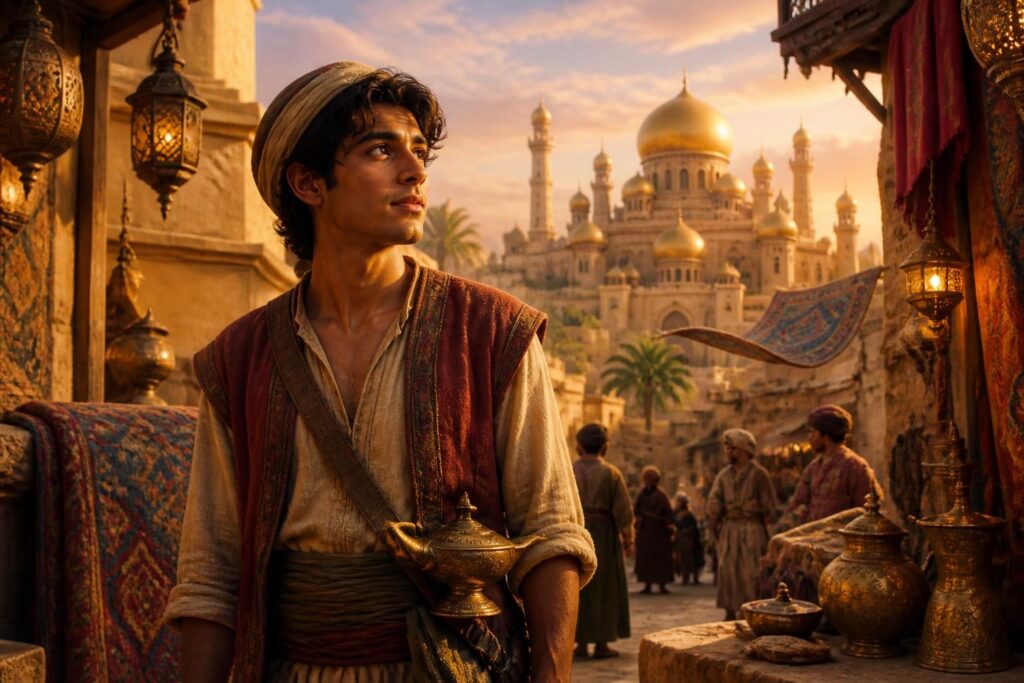
Over the centuries, Aladdin’s story has become one of the most enchanting tales in world heritage, blending magic, adventure, and dreams of emancipation. This captivating character, whose origin dates back to a late European addition to the story of One Thousand and One Nights, presents us with a humble young man thrust into the heart of a mystical world thanks to a magic lamp and an extraordinary genie. The 1992 Disney film, while freely inspired by this source, reinvented this hero to give him accessible modernity and reach a contemporary audience. Between fights in the dusty streets of Agrabah and flying carpets, the tale weaves a journey at the crossroads of cultures, where Eastern imagination meets the vibrant energy of Western cinema.
In an era where adaptations multiply, Aladdin remains an iconic figure, portrayed on screen, stage, and even in video games, crossing generations and formats. The magic of the traditional tale, enriched by Disney’s artistic creativity, invites an in-depth exploration of its story, transformations, and the lasting impact of this character through the eyes of today’s families and children.
Origin of the character Aladdin in the story of One Thousand and One Nights
Aladdin’s story traces its roots to a late addition to the famous collection of One Thousand and One Nights, thanks to the European translation and adaptation carried out by Antoine Galland in the 18th century. This insertion, although now part of the mythical corpus of this masterpiece of Oriental literature, brings a unique tale blending Arab-Persian influences and elements from Galland’s own travels. Young Aladdin is presented as a poor boy living in China who, through a magic lamp housing a genie, gains extraordinary powers and fascinating adventures.
This tale invites reflection on fundamental values such as perseverance, cleverness in the face of adversity, and the importance of a pure heart. Aladdin’s adventures, from his encounter with a malevolent magician to the conquest of his fate, transcend simple folklore to become a universal symbol of hope and transformation, themes that still resonate widely in 2026 in the hearts of children and adults.
The Disney adaptation: a modernized and endearing hero
The transition from tale to big screen gave Aladdin a new life, where the protagonist gains modernity and accessibility. Disney studios transformed this young man into a sympathetic hero, a street kid of Agrabah, a fictional city created to avoid sensitive historical connotations, like a raw jewel full of hope and courage. This change reflects contemporary values of justice and altruism, where Aladdin does not steal out of vice but from necessity, and seeks to win Jasmine’s love with honor.
The visual aspect of the character, conceptualized by Glen Keane, combines charm and diverse cultural influences, referencing icons like Tom Cruise for style and MC Hammer for liveliness, giving birth to a figure both rooted in his time and timeless. This vision captivated children worldwide, reinforced by an original voice performed by Scott Weinger and memorable songs composed by Alan Menken.
Artistic and narrative choices of Disney in the Aladdin film
Disney’s 1992 adaptation of Aladdin does not merely reproduce the original tale. It offers a rich interpretation, mixing Eastern influences and traits of American culture. The creation of Agrabah, a fictional city with a setting inspired by numerous Middle Eastern and Asian countries, makes the story universally accessible without political friction. The introduction of the comic genie, voiced by the unforgettable Robin Williams, brings a new breath, oscillating between humor and depth.
The screenplay blends magic, humor, and moral values, while the lively soundtrack energizes the events, breathing life into an ancient tale renewed for an exciting adventure. The film thus marked a golden age for the studio, distinguished by the richness of its visual details and the intensity of transmitted emotions, reinforcing Aladdin’s place in world cultural heritage.
Aladdin adaptations: from the big screen to video games
Since the release of the animated film, Aladdin has experienced numerous adaptations across various stages and screens. Several animated sequels such as “The Return of Jafar” and “Aladdin and the King of Thieves,” a television series exploring other facets of Aladdin’s adventures in Agrabah, as well as a highly popular stage musical since 2011, stand out. The 2019 live-action film, directed by Guy Ritchie with Mena Massoud in the title role, also helps maintain enthusiasm for the tale.
In the video game world, the character appeared on consoles as early as the 1990s, renewing in crossover universes like Kingdom Hearts or Disney Magic Kingdoms, and more recently in popular games in 2026. This omnipresence illustrates the narrative richness and Aladdin’s ability to adapt, becoming a genuine emblem of contemporary popular culture.
| Medium | Title | Date | Feature |
|---|---|---|---|
| Animated film | Aladdin (classic) | 1992 | Free adaptation of the tale, introduction of the comic genie and Agrabah |
| Live-action film | Aladdin | 2019 | Modern reinterpretation with real actors, extended characters |
| TV series | Aladdin | 1994-1995 | Animated sequel with new adventures |
| Musical | Disney’s Aladdin: The New Stage Musical | 2011-present | World tour and new numbers |
| Video game | Aladdin (SEGA Mega Drive) | 1993 | Platform game inspired by the film |
| Video game | Kingdom Hearts | 2002 | Disney crossover universe, playable Agrabah |
Aladdin, a universal symbol between dream and reality
More than a simple story character, Aladdin embodies a timeless symbol of hope and transformation, an invitation to believe in the power of the heart and in the possibility of changing one’s destiny. Whether the original or his Disney incarnation, this hero carries a message accessible to all generations: with perseverance and courage, even the toughest challenge can be overcome.
In real life, what I see with children is that this story structures their imagination around strong notions such as justice, kindness, and creativity. A little tip I often use to nurture this magic is to propose artistic activities around Aladdin, to prepare in 5 minutes flat, such as creating a salt dough lamp or a shadow puppet theater featuring the genie. You can adapt according to age and daily energy, thus fostering a lasting connection with this magical story.
- Aladdin originates from an 18th-century European adaptation of One Thousand and One Nights.
- Disney modernizes and humanizes this hero into a young thief with a big heart from Agrabah.
- The 1992 film blends magic, humor, and Eastern aesthetics for a universal tale.
- Several sequels, series, video games, and a musical extend his legacy.
- Aladdin remains a symbol of hope, courage, and transformation across generations.
What is the exact origin of the Aladdin tale?
The Aladdin tale was added late to One Thousand and One Nights in the 18th century by Antoine Galland, a French orientalist, who adapted it from a mix of Arab-Persian influences drawn from his travels.
How did Disney adapt the traditional Aladdin story?
Disney modernized the character, making him more sympathetic and altruistic, notably through a musically accessible version with humor, while preserving the magical essence around the genie and the lamp.
Why was the city of Agrabah invented?
Agrabah is a fictional city created to avoid any political or historical charge, notably in the context of the Gulf War, combining various Eastern settings for a universal world.
Who voices Aladdin in the original version?
Actor Scott Weinger provides Aladdin’s speaking voice in the original version, while Brad Kane performs the songs.
What are the main Aladdin adaptations besides the original film?
Besides animated sequels and the TV series, Aladdin appears in a Broadway musical, various video games, and international Disney parks.