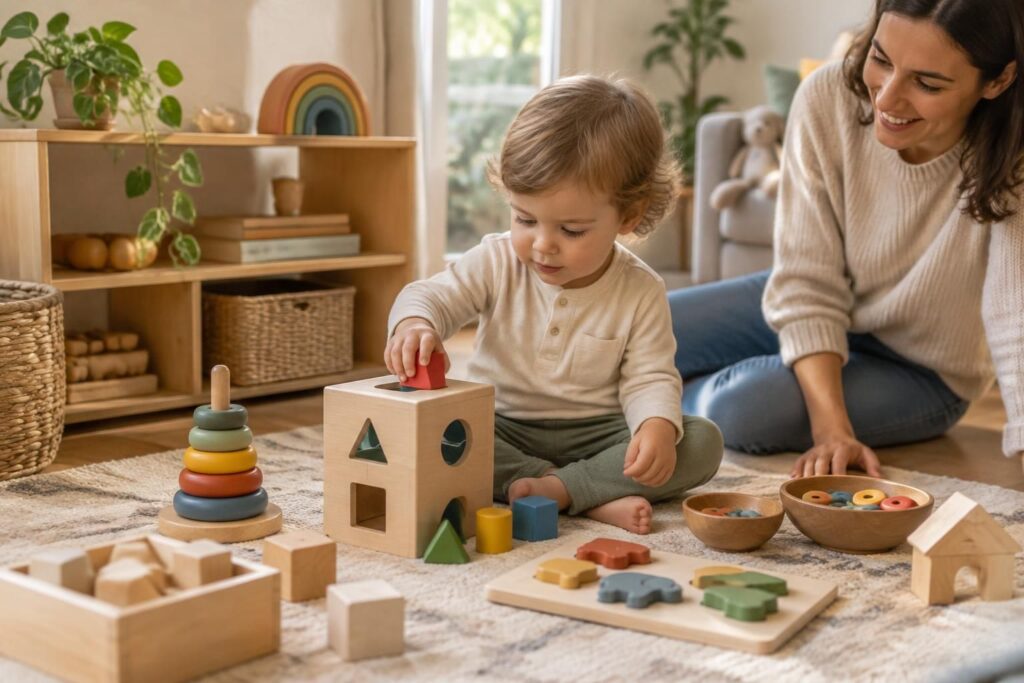
At 2 years old, a spoon becomes a tool for transferring, a box a treasure to fill and empty, a puzzle a little riddle to solve again and again. These gestures, sometimes very simple, nurture the awakening of toddlers: the child observes, tries, repeats, and gradually discovers what they can do by themselves. Montessori games for 2-year-olds have precisely this purpose: to offer an accessible, concrete, and sufficiently interesting activity to invite action, without turning daily life into a classroom.
To choose, there is no need to accumulate educational toys. A puzzle with large knobs, a few sturdy blocks, or a practical life tray can support fine motor skills, hand-eye coordination, and the child’s autonomy. In real life, it is often ordinary moments that capture attention best: putting objects in a basket, stacking two pieces, observing an image, or helping to wipe up a small spill. The key is to adapt the activity to the child’s interest and energy of the day, then let the toddler explore at their own pace. Here are some ideas for choosing simple, safe Montessori activities that are easy to integrate at home.
In short: which Montessori games to choose at 2 years old?
- Focus on one activity at a time: a shape puzzle or a stacking game helps the child concentrate on a clear gesture.
- Choose objects that are easy to handle: pieces large enough and simple grips encourage independent trials.
- Think about daily life: pouring, sorting, or tidying can become learning activities through play.
- Limit the number of visible options: a few accessible games make the choice clearer and foster attention.
- Stay close to the child: at this age, safety and supervision are especially important, notably with small pieces.
Why Montessori games at 2 years old support toddlers’ awakening
At this age, children learn a lot by acting. They grasp, move, compare, and repeat; these experiences contribute to the child’s development by engaging gestures, attention, and understanding of the surrounding world. Simple materials leave a real place for initiative: the child does, rather than watching a toy perform the action for them.
A well-chosen game does not need to be complex. A small puzzle offering only one shape to replace, for example, allows focusing on observation and adjustment of the gesture. If the child prefers stacking blocks or lining them up, this exploration is just as interesting: the game becomes an opportunity to try and discover, without expecting perfect results.
A simple activity to develop fine motor skills
Fine motor skills develop when the child uses their fingers and hands to grasp, turn, place, or stack. Large pieces easy to grip, blocks, or a suitable shape box allow practice at their own pace. Hand-eye coordination builds especially when the child looks at a piece, guides it towards an opening, and adjusts their movement.
A small familiar scene: Noah, 2 years old, sometimes abandons sitting games but comes back several times to a tower of cubes. He places one, watches it fall, then tries again with a wider base. These repetitions are not a detour: they lie at the heart of learning through play.
Our favorite Montessori games for a 2-year-old child
The most useful games are often those that match an already visible interest. Does the child like fitting things together, carrying, opening, and closing? An activity board or a puzzle can offer new ways to exercise these gestures. Do they prefer building and knocking down? Sturdy blocks allow more freedom.
| Game or activity | What the child explores | To check when choosing |
|---|---|---|
| Puzzle with large knobs | Shapes, piece grasping, and hand-eye coordination | Sturdy pieces, suitable for small hands, and no detachable dangerous elements |
| Wooden construction blocks | Balance, stacking, and spatial relations | Blocks large enough, smooth edges, and adapted finish |
| Simple activity board | Manipulation, rotational gestures, and exploration | Sturdy fixings, elements not easily detachable |
| Sorting game with large objects | Observation, comparison, and classification | Objects big enough and activity offered under supervision |
| Small practical life tray | Pouring, moving, or tidying with suitable material | Stable containers and safe contents, without small parts that could be put in the mouth |
Puzzles, blocks, and manipulation boards
A wooden puzzle with large knobs can be a good first fitting game: the handle facilitates grasping, and each piece invites observing a shape. Blocks do not impose a single way of playing. They can become a tower, a row, or a small scene for figurines suited to the child’s age.
An activity board may also interest a toddler who likes to turn, push, or slide elements. Before offering it, it is useful to check the sturdiness of the pieces and finish quality. The ideal game is one the child can explore without being overwhelmed by functions that do everything for them.
These supports can also be complemented by very simple sensory games: touching different materials, observing everyday objects, or listening to the sound of a block set on the table. For ideas related to growth stages, also discover practical guidelines on supporting child development.
Everyday Montessori activities to encourage the child’s autonomy
Montessori games are not limited to purchased toys. Participating in small daily gestures can also offer a rich experience, provided the material is adapted and the adult remains present. Putting towels in a basket, carrying a light object, or wiping a small surface give the child the opportunity to feel like an active participant.
At home, a tray prepared with two large containers and an easy-to-grasp object may be enough for a transferring activity. Seeds and small elements pose a choking hazard at this age: better avoid them if the child still puts objects in the mouth. Large, unbreakable objects suited to their age are a safer option, always under supervision.
Three easy ideas to propose
- Sort large objects: offer a few bulky pieces and two baskets, then let the child move or group them as they wish.
- Stack and build: provide a few blocks to build a tower, create a line, or simply explore their balance.
- Take part in tidying up: invite the child to put a toy back in its basket, without aiming for perfect tidiness.
These proposals benefit from remaining short and flexible. If the child drifts away, the activity can simply be tidied up; if they return later, it is still there. For ideas around first words and images, this resource on how to support the child towards reading complements language and observation games well.
How to choose educational toys suitable for 2 years old
When choosing among educational toys, it’s better to first look at what the child likes to do. A toddler attracted by openings may appreciate a shape sorter; one who enjoys building may prefer blocks. The activity should be accessible enough to encourage trying, without being so easy that it no longer sparks curiosity.
Natural materials like wood offer different textures and weights, but they don’t automatically make a toy suitable. Sturdiness, size of elements, finishes, and manufacturer recommendations remain essential. At 2 years, adult supervision is particularly important, especially when a game has moving parts or small accessories.
Prepare a clear space without multiplying toys
A low shelf with a few visible activities helps the child choose and find what they know. There’s no need to present the entire collection: rotating some games from time to time can revive interest without new purchases. A tray or basket per activity also facilitates tidying and provides a simple reference.
When a new game is presented, a few slow gestures suffice to show how to start. Then the adult can observe without correcting each attempt. Allowing room for error and repetition helps the child build confidence, while a calm atmosphere makes the game more enjoyable for everyone.
Printable supports can provide activity ideas or help organize a proposal, but they are not essential. A basket, adapted objects, and a little availability often suffice to create a moment of exploration. To better understand the profession and support of young children, here is an insight into the role of a early childhood educator.
Frequently asked questions about Montessori games for 2-year-olds
Each child progresses at their own pace: the age indicated on a toy is a guideline, not an obligation to succeed in an activity. These answers help choose simply and keep the pleasure at the center of play.
Which Montessori games to offer a 2-year-old child?
Puzzles with large knobs, sturdy construction blocks, simple manipulation boards, and sorting activities with large objects are good options. Choose according to the child’s interests and always check that the game is suitable for their age.
Should one buy specific Montessori materials?
No. Many activities rely on everyday objects, provided they are sturdy, clean, appropriate for the age, and used under supervision. Well-chosen materials matter more than a large quantity of toys.
How many games should be made available?
A few visible and accessible activities can suffice. Presenting a limited selection helps the child choose; games can be rotated according to their interests, without a rigid schedule.
What to do if my child is not interested in a game?
Do not force the activity. Put it away and offer it again later, or choose a game closer to what the child already likes to do. Their lack of interest is useful information about their current desires.
Do Montessori games replace free play?
No. Montessori activities complement free play, books, outings, and shared moments. These varied experiences together contribute to the child’s awakening and development.


