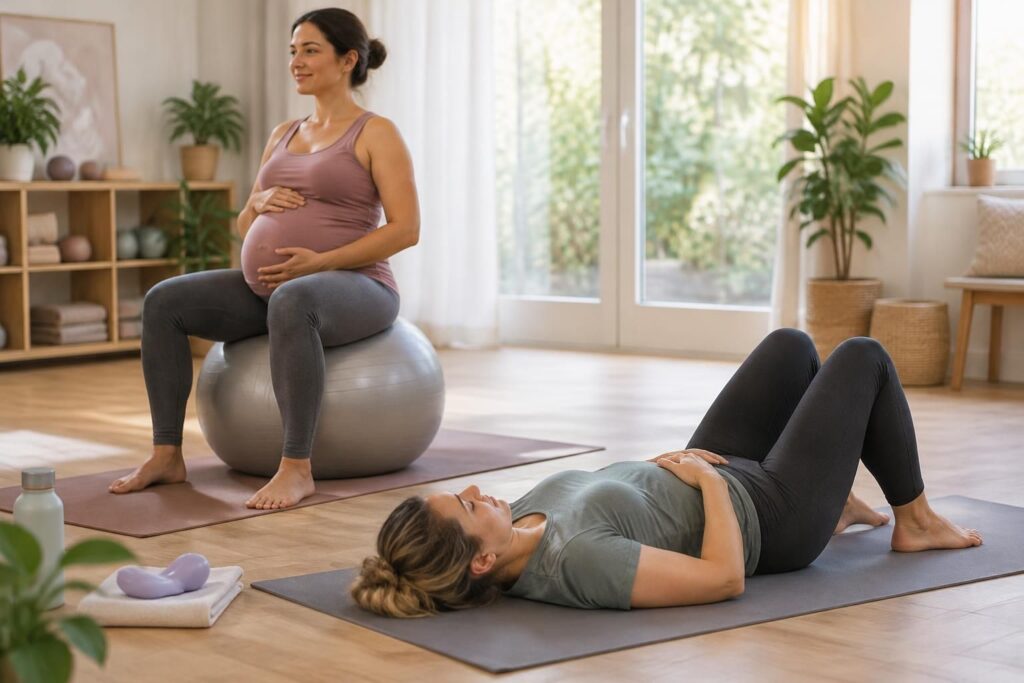
During pregnancy, the perineum supports the increasing weight of the uterus and accompanies the changes in the pelvis. After birth, it may need time and sometimes support to regain its bearings. This group of muscles, located between the pubis and the coccyx, forms a true hammock under the organs of the pelvis: it helps support them, urinary and anal continence, and intimate comfort. Strengthening it does not mean squeezing as hard as possible, nor multiplying the contractions. The quality of the movement, breathing, and the ability to relax are just as important.
For Camille, a young fictional mother, the realization came when she understood that a correct contraction resembled more a movement that rises gently than a push downwards. Perineum exercises for women can be adapted to pregnancy as well as postpartum, but the right time and method depend on sensations, the delivery, and the assessment of a professional. Kegel exercises, follow-up with a midwife or physiotherapist, home devices: each option has its place, provided it does not replace an evaluation with a routine chosen at random.
In brief
- During pregnancy, gentle contractions and fluid breathing help to become aware of the pelvic floor, without seeking performance.
- After delivery, recovery is gradual; the postnatal visit allows discussing rehabilitation needs.
- An effective contraction slightly lifts the perineal area, without pushing, holding the breath, or excessively tightening the buttocks.
- Devices and accessories are not suitable for every situation: it is better to seek advice before using them.
- Leaks, pain, or heaviness are good reasons to consult a midwife, doctor, or specialized physiotherapist.
Strengthening the perineum: understanding its role during pregnancy
The perineum, also called the pelvic floor, is made up of several muscle layers and support tissues. It stretches under the pelvis, between the pubis and the base of the spine, and helps support the bladder, uterus, vagina, and rectum. It also helps retain urine and stool, while participating in intimate sensations.
Throughout pregnancy, the weight of the uterus and hormonal changes put these tissues under strain. This does not mean that every pregnant woman should follow the same program: some need to learn to contract, others to relax, especially in cases of tension or pain. Perineal preparation for childbirth thus also aims to better know this area and preserve its flexibility.
Gentle exercises for the perineum during pregnancy
To locate the muscles, imagine you are holding back gas: the area around the anus and vagina tightens slightly and lifts inward. Try some light contractions, then relax completely while continuing to breathe. The goal is to feel the movement, not to hold it for a long time or to force.
You can practice lying on your side, sitting, or standing, depending on the most comfortable position. A small routine can combine some slow breaths, brief contractions, and an equivalent relaxation time. In case of pain, pressure sensation, or pregnancy requiring special precautions, seek advice from your care team before continuing.
Kegel exercises: precision before repetition
Kegel exercises consist of contracting then relaxing the pelvic floor muscles. A successful contraction remains gentle and targeted: the belly, thighs, and buttocks do not take over, and breathing is not held. If the movement seems vague, a professional can help identify the right muscles.
The test of stopping the urine stream can sometimes serve as a punctual guide, but it should not be made a regular exercise: frequently interrupting urination can disturb bladder emptying. To progress, it is better to train at another time, without rushing.
Perineal rehabilitation after childbirth: when to resume?
After birth, the perineum can be stretched and sensations sometimes unusual. Some stress leaks or a feeling of heaviness may occur, but they should not be trivialized if they persist or interfere with daily life. A tear, episiotomy, or cesarean section alone do not determine the program: the assessment considers recovery and each person’s symptoms.
The postnatal visit, usually organized around six to eight weeks after birth, allows sharing sensations and reviewing the need for rehabilitation. Active exercises and supervised sessions begin at the time deemed appropriate by the professional. Before that, rest, comfortable breathing, and resuming daily activities without pain remain priorities.
Support adapted to symptoms and sensations
Perineal rehabilitation after childbirth can be provided by a midwife or physiotherapist trained in this care. Follow-up can include guided exercises, manual work with consent, or biofeedback, a method that helps visualize muscle activity. The goal is to regain an effective contraction, but also complete relaxation.
The number of sessions varies depending on the assessment and progress; there is no identical duration for all. Prescribed sessions can be covered according to Health Insurance rules and the patient’s situation. To understand the different approaches, also consult this guide on methods to strengthen the perineum.
| Situation | Useful reference | To prioritize |
|---|---|---|
| Pregnancy without particular symptom | Comfort and breathing guide practice | Gentle contractions, mobility, and relaxation |
| After delivery | Review during postnatal follow-up | Gradual resumption according to professional assessment |
| Leaks, pain, or heaviness | Do not wait for discomfort to settle in | Request an assessment with a health professional |
| Difficult to feel contraction | Avoid compensating with abdominal or gluteal muscles | Get guided, possibly with biofeedback |
Perineal rehabilitation device and accessories: what to choose?
A perineal rehabilitation device is not mandatory. Some devices offer biofeedback to visualize a contraction; others use electrical stimulation, which triggers muscle contractions using impulses. Their usefulness depends on the assessment, symptoms, and ability to contract. Professional advice helps choose a suitable device and use it correctly.
A perineal probe is placed in the vagina and can be connected to a biofeedback or electrical stimulation device. It is not automatically suitable for all women, especially in case of pain, infection or ongoing healing: the manufacturer’s instructions and those of the professional supervising rehabilitation must be followed. Vaginal cones and geisha balls do not replace care when needed and are not recommended without proper advice, especially during the postpartum period.
Devices do not replace learning the correct movement
A device can provide useful feedback, but it alone does not correct a push downwards or a contraction performed while holding the breath. If the perineum is painful or too tense, strengthening it more is not necessarily the right answer: relaxation and coordination can then be central to the work. The right tool is the one that meets an identified need, not the one that promises the fastest result.
For some women, exercises without equipment, guided during sessions, are enough. Others benefit from support with biofeedback or a complementary technique chosen according to their situation. The overview of perineal rehabilitation techniques can help prepare questions to ask during consultation.
Daily pelvic floor strengthening: the right reflexes
Pelvic floor strengthening is not limited to exercise sessions. Repeated coughing, constipation, carrying loads or high-impact activities can increase pressure exerted on this area. Exhaling while making an effort and avoiding pushing while holding the breath are simple habits to work on, without trying to contract constantly.
Resuming running, jumping, or intense sports is done gradually, depending on recovery and symptoms. A walk, gentle activity or some mobility movements can be a comfortable first step. Camille, for example, chooses to check how her body responds to a walk before extending the duration: this concrete reference is better than a rigid schedule.
Guidelines for a pressure-free routine
A short and regular practice is often easier to integrate than a long occasional session. Remember to alternate contraction and relaxation: a muscle that only knows how to tighten does not function optimally. In case of persistent leaks, pain, sensation of organ prolapse, or discomfort during intercourse, make an appointment for an assessment.
- Choose a position where the pelvis can relax, then breathe calmly.
- Contract gently as if holding back gas, without pushing downwards.
- Fully relax before the next repetition and observe the sensations.
- Stop if there is pain or discomfort and seek advice if the movement remains difficult.
Regularity helps, but it should never become an additional obligation: the right rhythm is the one that respects recovery and daily life.
Frequently asked questions about perineum exercises and devices
Can the perineum be strengthened during pregnancy?
Yes, gentle exercises can help better feel the muscles and prepare the pelvis. They must remain comfortable, without pain or breath-holding, and be adapted with a professional in case of a particular pregnancy or symptoms.
When to start postpartum perineal rehabilitation?
The timing depends on recovery and the postnatal assessment, usually performed around six to eight weeks after birth. The midwife or doctor can guide towards rehabilitation and specify when to resume active exercises.
Are Kegel exercises enough after delivery?
Not always. They can be useful if the contraction is well performed, but an assessment allows verifying strength, coordination, and relaxation of the perineum, then choosing appropriate exercises.
Is a perineal rehabilitation device necessary?
No. Biofeedback or electrical stimulation devices can help in certain situations, but they are not essential and must be used with appropriate advice, especially after delivery.
What signs should lead to consulting a professional?
Repeated urinary or anal leaks, a sensation of heaviness, pelvic pain, or persistent intimate discomfort justify discussing with a health professional.