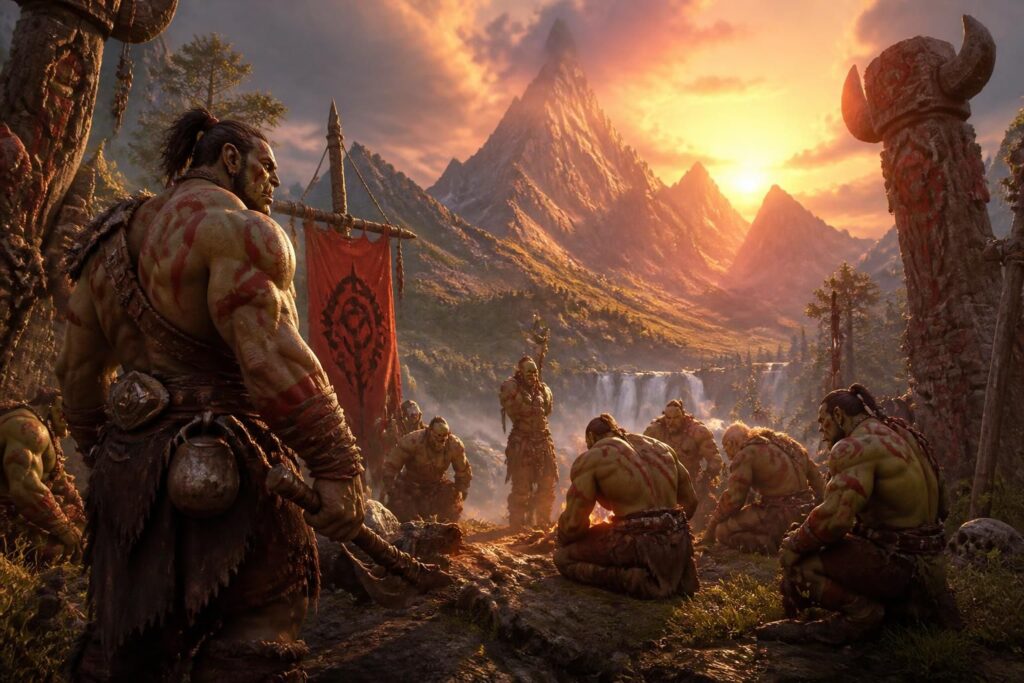
The Orcs occupy a major place in the rich and complex universe of Warcraft, a saga where fantasy comes to life through dense and captivating tales. Their story begins on the ancient world of Draenor, the legendary cradle of this fascinating tribe. Far from the clichés of the simple brutal warrior, the Orcs are rooted in a deeply ritualistic and spiritual tradition, with a close connection to shamanism and elemental forces. Their journey is also one of relentless struggle, between dark forces and an aspiration for redemption that guides their steps to Azeroth, where they become a key player of the Horde, subjected to multiple conflicts and transformations. In this article, the exploration of the mythical origins of the Orcs reveals how their identity is woven both in legend, war, and a quest for balance against demonic corruption. A story that carries universal themes of transformation, honor, and brotherhood at the heart of fantasy.
To summarize:
- Origins on Draenor: clan-based, rooted in shamanism and the respect of spirits.
- Demonic corruption: by the Burning Legion through fel magic and Mannoroth’s blood.
- Foundation of the Horde: transformation into a military force and expansion to Azeroth.
- Renewal with Thrall: return to ancestral values and establishment of a new Horde.
- Modern divisions and conflicts: internal tensions on Orc identity and future.
The Orcs of Warcraft: a clan-based origin rooted in shamanism
In the beginning, the Orcs lived on the world of Draenor, a universe where different races coexisted, notably the draenei. In this setting, the orc society was organized into autonomous clans, each preserving its traditions, without denying the common values centered on respect for the spirits of nature. Shamanism held a central place in this culture, embodied by important figures like Ner’zhul, who symbolized the deep link between the Orcs and elemental forces.
They were not a politically united people, but together they formed a rich civilization, structured around the principles of honor, strength, and a sacred relationship with their ancestors. This respect for natural balances allowed each clan to live in harmony with its environment. In real life, one could compare this model to some human societies where spirituality is an essential social bond, offering a secure framework and a community connection.
Demonic Corruption and the Birth of the Demonic Horde
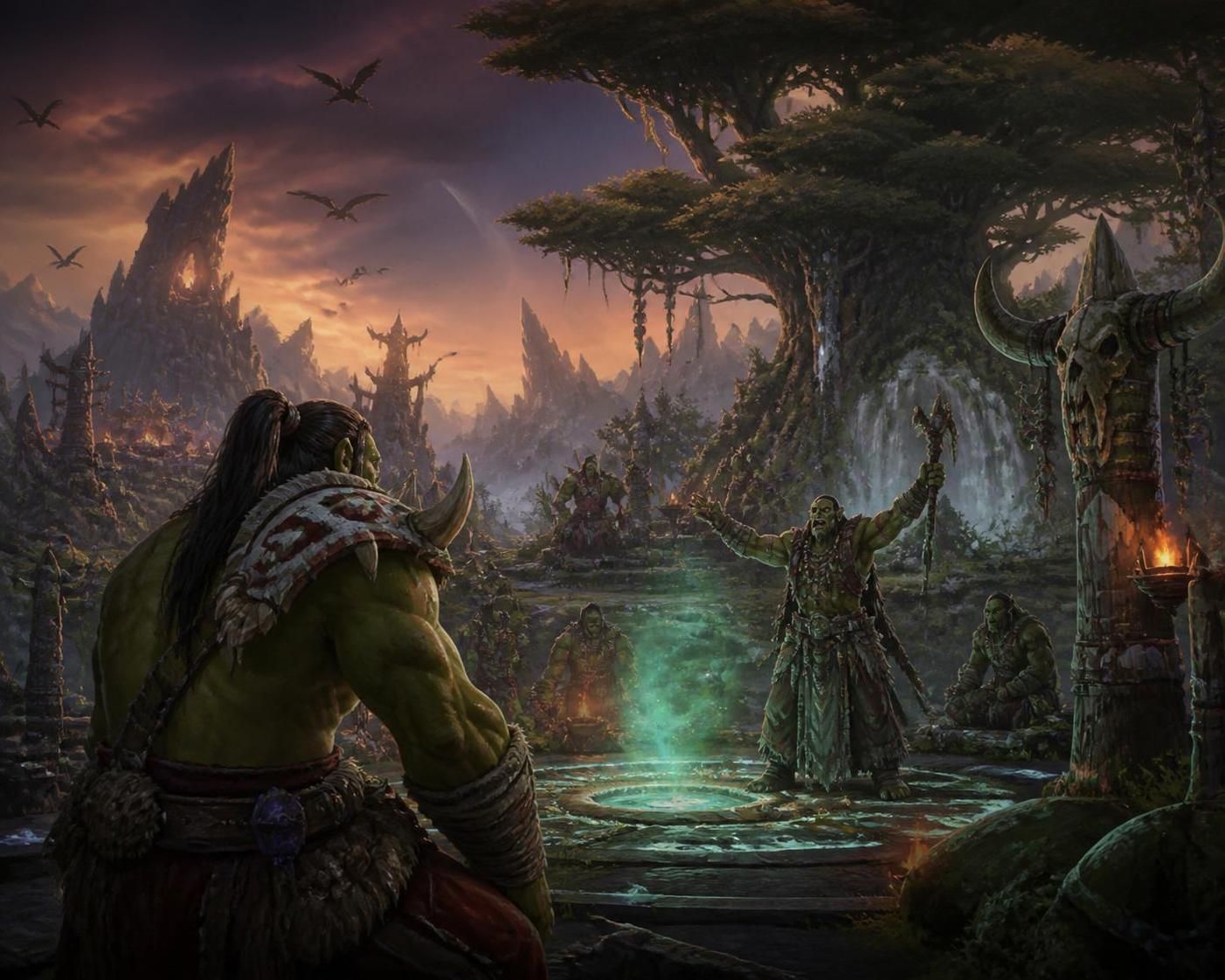
This peaceful world was overturned with the arrival of the Burning Legion, or more precisely with the manipulation of Kil’jaeden. He used Ner’zhul through spiritual falsifications, inciting him to consider the draenei as enemies. Not immediately realizing the deception, Ner’zhul led his people into a disastrous conflict. By the time they understood the scheme, the corruption was already well advanced.
The character of Gul’dan then became a key tool in this dark process. Under his influence, traditional shamanism was replaced by fel magic, more aggressive and destructive. The ritual of Mannoroth’s blood is the indelible mark of this transformation, sealing the Orcs’ dependence on this corrupted magic and exacerbating their natural ferocity. This is how the Demonic Horde emerged, a military empire devoted to war and conquest.
The Conquest of Azeroth and the Emerging Conflicts of the Horde
The opening of the Dark Portal marks the beginning of the massive migration of Orcs to Azeroth, triggering the First War. This invasion opens a tumultuous chapter where the orc tribe, now united under a black banner and perverted magic, confronts human kingdoms. The power of this new Horde is considerable, to the point that the fall of Stormwind clearly illustrates the threat.
Yet, the reaction of the human Alliance during the Second War redraws the balances: the Horde is pushed back, partly collapses, and its members are captured. This period reveals the profound consequences of corruption: deprived of fel magic, many Orcs fall into despair and loss of identity.
The Return to Balance with Thrall and the Rebirth of the New Horde
A light emerges in the figure of Thrall, son of the legendary Durotan, raised far from his people among humans. His discovery of orc traditions allows him to reject the demonic shadow still darkening the Horde. He sparks a reconstruction movement where shamanism regains its place, embodying a return to a lifestyle respectful of the spirits and nature.
The migration to Kalimdor and the founding of Orgrimmar city lay the foundation for a diverse Horde, now welcoming other peoples such as the Taurens and Trolls. This new breath advocates honor and balance, far from past violence and manipulation.
Paths of Tension and Confrontations within the Modern Horde
However, this new phase does not end divisions. The personalities of Grommash Hellscream then Garrosh Hellscream embody more belligerent currents, reveal expansionist ambitions, and rekindle internal conflicts. The Horde wavers between its glorious heritage and a constant quest for meaning.
These tensions illustrate well, like a complex family, the challenges faced by societies in mutation, combining ancient traditions and the realities of a world always in motion. The Orcs thus continue to embody this inner struggle between past and future, reinforcing the historical and emotional depth of their saga.
| Period | Key Events | Consequences on the Orcs |
|---|---|---|
| Origins (Draenor) | Clan life, dominant shamanism | Cultural cohesion, ancestral respect |
| Corruption by the Burning Legion | Manipulation of Ner’zhul and Gul’dan | Spiritual and physical decline |
| First and Second War | Invasion of Azeroth, fights against the Alliance | Initial victory, then defeat, loss of identity |
| Thrall Era | Liberation, return to shamanism, founding of Orgrimmar | Renewal and symbolic reconstruction |
| Modern Horde | Internal tensions, conflicts between leaders | Divisions and identity evolution |
To better understand the legendary origins and the complex dynamics of the Orcs in Warcraft, here is a condensed list of the essential points:
- The powerful tradition of unique shamanism, embodying the connection to the natural world and spirits.
- The tragedy of corruption orchestrated by demonic forces, which deeply upset the orc soul.
- The decisive influence of key figures like Ner’zhul, Gul’dan, and Thrall on the tribe’s evolution.
- The transition from a violent demonic Horde to a modernized and plural Horde, founded on renewed values.
- The recent internal conflicts that reflect tensions between tradition and adaptation to current challenges.
Where do the Orcs originally come from in the Warcraft universe?
The Orcs are originally from Draenor, a world populated by clans very attached to shamanism and ancestral traditions, where the draenei also coexisted.
How did the Burning Legion corrupt the Orcs?
Through the manipulation of Ner’zhul and Gul’dan, the Legion replaced shamanism with fel magic and established a dependence on Mannoroth’s demonic blood, transforming the Orcs into a formidable weapon.
What role did Thrall play in the history of the Orcs?
Thrall freed the Orcs from internment camps, restored traditional shamanism, and founded the new Horde, based on honor and balance with the elements.
Why does the Horde experience internal conflicts?
The divisions arise from different visions regarding orc identity: some leaders advocate redemption and balance, others, like the Hellscreams, a more warlike and expansionist approach.
Are the Orcs still unified today?
Nowadays, Orcs are present in several groups, notably the Horde and the Mag’har Orcs from an alternate Draenor, reflecting growing cultural and political diversity.