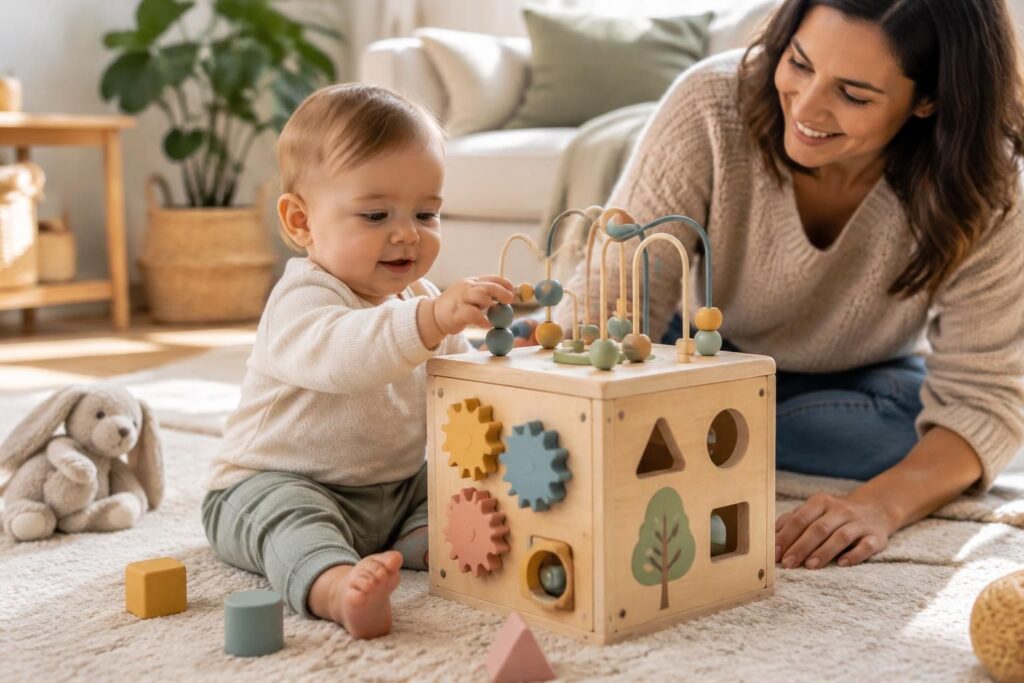
A baby activity cube attracts little hands with its shapes to turn, its beads to slide, and its textures to explore. But at what moment does it really become interesting? The age indicated on the packaging provides a first guideline; the child’s abilities, their desire to manipulate, and the safety of the model are just as important. Some babies first observe the colors, others already try to grasp and rotate each element.
Generally, a cube can be offered when baby begins to sit more confidently and deliberately grasp objects, often around 6 months, provided the model is suitable for that age. It then supports the baby’s sensory development, fine motor skills, and hand-eye coordination, without any need to show how to play or to wait for specific progress. A child may become fascinated with just one side for several days: this is already a great exploration.
To choose a baby activity cube, it is better to look beyond its appearance: dimensions, stability, accessible parts, materials, and manufacturer recommendations make the difference. A well-designed model offers simple and varied manipulations while allowing the child to try at their own pace. Here are the guidelines for finding a baby developmental toy that encourages exploration and remains suitable for daily life.
In brief: age and choice of a baby activity cube
- From when? Often around 6 months, when baby can grasp objects and play in a stable position, with a model explicitly adapted to their age.
- What is the interest? Manipulating, observing, and listening supports sensory awakening as well as precise gestures, without imposing any instructions.
- Which criteria to check? Stability, solidity, finishes, absence of small detachable parts, and safety indications from the manufacturer.
- How to offer it? On the floor, under adult supervision, for short explorations renewed according to the child’s interest.
- Which model to choose? A simple cube, easy to manipulate, and adapted to current abilities; wood is not essential for a toy to be interesting.
At what age to give a baby activity cube?
The ideal age to give a baby activity cube depends less on a precise date than on baby’s skills. Around 6 months, some children start to sit with support, reach out for objects, and transfer them from one hand to the other; others need more time. Age labels on the toy remain essential because cubes differ in weight, parts, and mechanisms.
Development benchmarks rather than a rigid age
Before offering the toy, observe if baby tries to grasp objects and can explore them in a comfortable, stable position. If the cube has elements to turn or slide, the child does not need to succeed at these gestures immediately: looking, touching, and tapping are already ways of playing.
For a very young child who cannot yet sit, a light and easy-to-reach toy may be more suitable than a bulky cube placed in front of them. The important thing is to choose an activity that matches their current abilities, not to anticipate a stage.
A short, free, and accompanied exploration
Place the cube on a stable mat, near baby, then give them time to discover the different sides. A very simple little scene: a child notices a colorful bead, follows it with their eyes, then tries to move it. This back-and-forth between observation and action nurtures attention, even if the game lasts only a few minutes.
Stay close during exploration and put the toy away if baby gets tired or loses interest. To complete a selection according to their age, this page gathers other ideas for gift ideas for a one-year-old baby.
The benefits of a developmental cube for development
A developmental cube often combines several experiences on a single base: shapes to follow with the eyes, materials to touch, elements to move, or sounds to listen to. This variety encourages baby’s sensory development and allows them to compare what they see, hear, and feel, without screen or imposed storyline.
Fine motor skills and hand-eye coordination
Grabbing a piece, moving it, or turning it involves small precise gestures: it’s a playful way to develop fine motor skills. When baby looks at an element then reaches for it, they also train hand-eye coordination. Attempts are not always successful at first, and it is precisely their repetition that makes the game interesting.
An effective cube does not need to accumulate features. A few distinct activities, easy to understand and reach, often leave more room for attention and initiative than a very busy toy.
A game that evolves with the child
At first, baby may mostly observe colors or touch surfaces; later, they will try to open, turn, move, or combine elements. This evolution makes the cube interesting over several stages, provided that its activities remain accessible and the child wants to come back to it.
The game can also become a little shared moment: the adult names a color or accompanies a movement, then lets the child take over. To discover other inspirations adapted to toddlers, browse this selection of gift ideas for one-year-old babies.
How to choose a baby activity cube that is suitable and safe
To choose a baby activity cube, start by checking the recommended age, then examine the toy concretely: does it hold well in place? Are the parts securely attached? Are the edges smooth? A safe activity cube must comply with the applicable toy standards and bear the necessary manufacturer information, notably warnings and age recommendations.
Wood, fabric or plastic: prioritize design
A wooden developmental cube can be appealing because of its feel and robustness, but the material alone does not guarantee quality or safety. Check the state of surfaces, absence of splinters, solidity of the paint, and ease of maintenance; for other materials, also pay attention to seams, assemblies, and any small parts.
Avoid a model with elements that could detach, accessible cords, or mechanisms that could pinch fingers. In case of cracks, loose parts, or damaged surfaces, stop offering the toy until it can be checked or replaced.
Criteria to compare before purchase
| Criterion | What to look for | Why it is useful |
|---|---|---|
| Recommended age | Manufacturer’s indications and warnings | They help choose activities suited to the child’s abilities and safety. |
| Stability | A cube that does not easily tip over during handling | Baby can explore without the base overturning at the slightest gesture. |
| Finishes | Smooth surfaces, solid assemblies, and non-sharp edges | Hands and mouth often explore the toy closely. |
| Activities | Some easy-to-reach and varied manipulations | The game remains clear and can follow the child’s interest. |
| Maintenance | Cleaning instructions and material resistance | An easy-to-maintain toy integrates better into everyday life. |
A high price or a large number of activities are not guarantees of relevance. The right choice is one that baby can look at, touch, and manipulate without difficulty, in an environment adapted to their age.
Installing the activity cube and supporting play
Present the cube in a clear space, on a stable surface, and stay with baby while they play. There’s no need to show all the functions at once: a single side is enough to awaken their curiosity, then they can move on to the next when they want.
Some simple gestures to enrich exploration
- Allow time to observe: wait for baby to show interest in a shape or texture before intervening.
- Put words on the action: “You’re turning the wheel” or “The bead slides” accompanies the game without directing it.
- Alternate moments: offer the cube when baby is available, then put it away when they show signs of tiredness.
- Check the toy regularly: verify that no part has loosened and follow the manufacturer’s maintenance instructions.
These small moments do not need to be long or perfectly organized. When the adult provides a safe environment and remains attentive, baby can take initiative and make each manipulation a discovery at their own pace.
Frequently asked questions about the baby activity cube
At what age can you offer a baby activity cube?
Many models are suitable from around 6 months, but the age recommended by the manufacturer and the child’s abilities remain essential benchmarks. Baby must be able to explore the toy in a comfortable position, under adult supervision.
Is a wooden activity cube preferable?
Not necessarily. Wood can be robust and pleasant to touch, but safety mostly depends on finishes, solidity of the parts, adaptation to age, and respect for the manufacturer’s instructions.
How long can a baby play with their cube?
There is no fixed duration: some children explore for a few minutes, others return for longer periods. Follow their interest and stop play if they show signs of tiredness or irritation.
How to verify that an activity cube is safe?
Check the recommended age, warnings, and manufacturer information. Before each use, check stability, surfaces, absence of loose or damaged parts, and always supervise baby during play.


