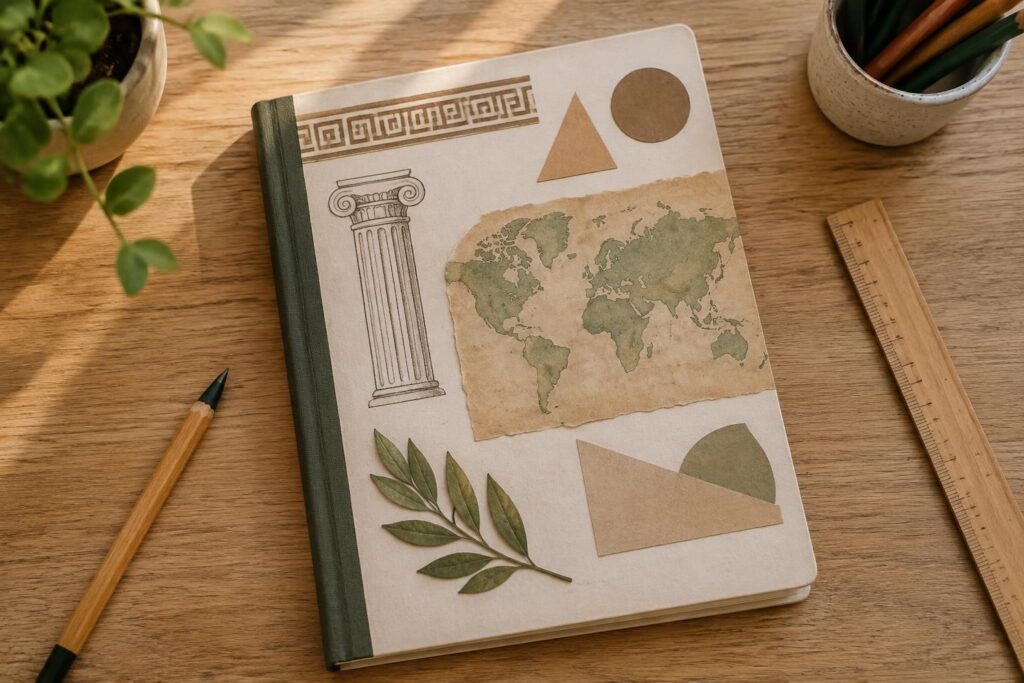
A history cover page can transform an ordinary notebook into an invitation to explore the past. A few well-chosen features are enough: a timeline, an old map, the silhouette of a historical monument, or even a historical drawing inspired by a studied period. The idea is not to fill every space but to create a personal setting that helps the child recognize their notebook and remember the main landmarks of the course.
In real life, what we see with children is that they take more initiative when they have a simple starting point. A title, two colors, and a small symbol can already give rise to a beautiful cover. A student passionate about dinosaurs might, for example, add a coloring illustration, while another might prefer a feather and an inkwell to evoke stories of old. These simple ideas can be adapted to the age, available materials, and the energy of the day: decoration then becomes a small creative moment without the pursuit of perfection.
In brief
- Choose a historical theme or a symbol related to the curriculum.
- Organize the elements around a readable title and a few colors.
- Add a timeline, an old map, or important dates.
- Favor easily found supplies and accessible drawings.
History cover page: choose a theme that inspires
Before taking out the markers, the child can choose a period or an atmosphere: Antiquity, the Middle Ages, the great explorations, or the French Revolution. This small choice gives direction to the drawing and prevents adding unrelated motifs. For a notebook dedicated to Antiquity, a Greek column, a vase, or a stylized mosaic immediately sets the tone.
A common thread also helps children who don’t know where to start. Lina, for example, can draw a small door in the center of her cover, then surround it with objects evoking the studied period: a crown, a boat, or a parchment. For a playful touch, a printable dinosaur coloring can be adapted to a theme about prehistory.
Historical motifs easy to draw
Simple shapes are often the most effective: a shield, a pyramid, a castle, or a compass are quickly recognizable, even without great drawing experience. It’s possible to start with a pencil, then trace the contours with a black marker once the composition suits.
For a notebook around historical stories, a border of small books, parchments, or feathers creates a coherent setting. A feather and an inkwell drawn near the title recall the written traces that allow telling and understanding the past.
Notebook decoration: organizing the title and landmarks
A cover pleasant to look at remains first of all easy to read. The title “History” can occupy the center or the top of the page, with the first name and class in a reserved space. Around, a few well-spaced elements give depth without hindering important information.
The timeline is both a decorative and useful option. A line, a few markers, and two or three important dates are enough to evoke a period; the child can also replace the dates with small symbols if they prefer a visual approach. To complete a creative session, children who like word games will enjoy these history jokes, to share during a break.
The video can serve as a starting point, but nothing forces to reproduce a model identically. Leaving room for a personal idea — a detail, a color, or a symbol chosen by the child — makes the cover more meaningful.
A simple composition in four steps
To avoid the page turning into an accumulation of drawings, a small method helps to visualize the result. The child thus keeps the freedom to create while knowing where to place each element.
- Write the title in pencil and reserve space for the first name.
- Choose a main motif, like an old map or a historical monument.
- Add two or three details, for example a frieze, a book, or a compass.
- Color with a limited palette to keep a harmonious cover.
This organization suits both a heavily drawn page and a minimalist decoration. The most important is that the information remains readable and that the child recognizes their notebook at first glance.
Simple cover page ideas according to available materials
Nice decoration does not necessarily require particular supplies. Pencils, a ruler, and some scraps of paper may suffice; colored paper cut into strips becomes a border, while a small piece of kraft paper can evoke an old parchment.
The table below proposes easy-to-adapt combinations. Children can choose an idea, then simplify or enrich it according to their age and the time they have.
| Theme | Main motif | Simple material |
|---|---|---|
| Prehistory | Cave, footprints, or mammoth | Brown and orange pencils |
| Antiquity | Column, vase, or mosaic | Markers and small squares of paper |
| Middle Ages | Castle, coat of arms, or knight | Gray pencil and three colors |
| Explorations | Old map, compass, or boat | Kraft paper and ruler |
When drawing seems difficult
Cutting shapes out of paper, drawing lines with a ruler, or coloring a printed motif are all ways to participate. A hesitant child can start with a small old map drawn as an irregular rectangle, then add a dotted road and a compass rose.
Historical drawing does not need to be exact like a textbook illustration: it can remain symbolic as long as it evokes the chosen subject. A small scene inspired by a history book, accompanied by a clear title, can already tell an era with a lot of charm.
A few minutes of preparation avoid hesitation: choose the theme, place the title, and test colors on a draft. This short step then leaves more room for the pleasure of creating.
Decorate a history notebook without overloading the page
When ideas multiply, a gentle rule can help: keep a main motif, a visible title, and a few small details. Free spaces make the composition breathe and allow quick identification of the subject name. A fine border or a color code by period can complete the decor without weighing it down.
Accessories can also tell a story: a feather near a text, a compass next to a map, or a small open book under the title. These combinations give meaning to the drawings and remind that history is discovered through places, objects, and stories. A successful page is above all a page the child enjoys finding again.
Frequently asked questions about the history cover page
What can you draw on a history cover page?
A castle, an old map, a historical monument, a compass, or a timeline are easy to recognize and create. The motif can also be chosen according to the period studied in class.
How to make a quick notebook decoration?
Write the title, add a single main drawing, and complete with a border or a few important dates. With pencils and a ruler, the cover takes shape without special material.
How to help a child who can’t draw?
Offer them simple shapes to trace, a motif to color, or paper cutouts. They can also choose the colors and layout: a personal creation does not depend on drawing precision.
Should many dates be added on the cover?
No, a few landmarks are enough. One or two important dates, or a small timeline, evoke the course while keeping the title and first name easy to read.


