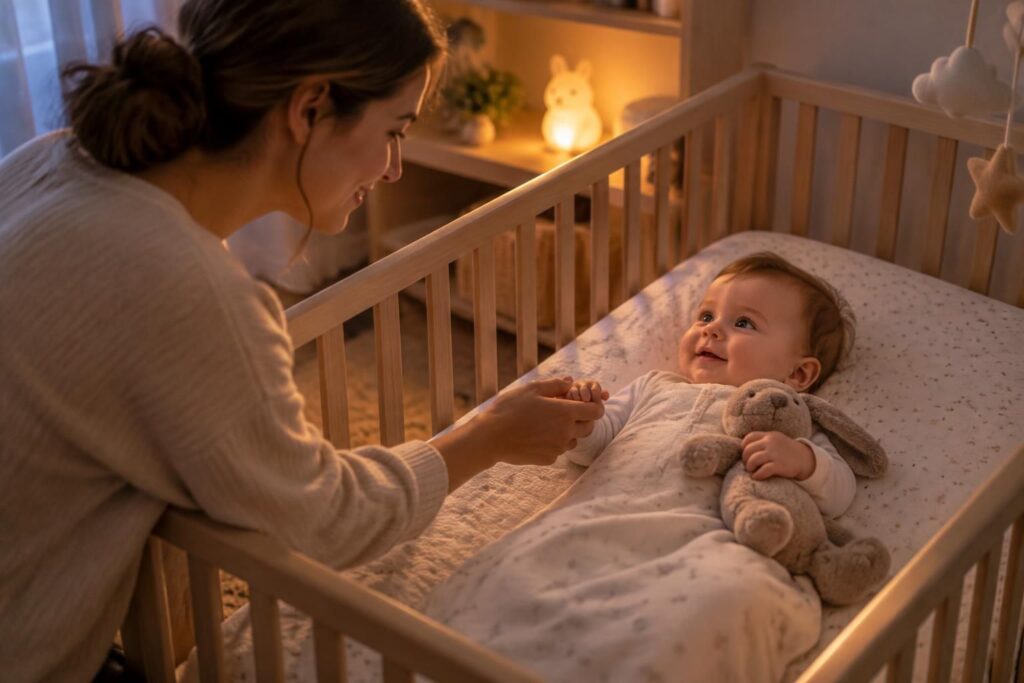
A crying baby when their parent leaves the room, demanding to be held at bedtime, or appearing reserved in front of a new face is not trying to “throw a tantrum.” They gradually discover that familiar people can go away, while still needing their presence to feel secure. This awareness, often called separation anxiety, is part of emotional development and can also affect the baby’s sleep.
The age of onset varies from one child to another: signs often become more visible between 6 and 9 months, then may intensify around the second year. Some babies express them a lot, others barely at all. If Lina, 10 months old, cries when her parent leaves the room, it neither means that she is “too dependent,” nor that she has been poorly accustomed. Predictable landmarks, announced separations, and a warm presence can help her get through this stage at her own pace.
In brief: fear of abandonment in babies and sleep
- A common stage, not a tantrum: separation anxiety accompanies the maturation and recognition of familiar people.
- A variable age: reactions often appear between 6 and 9 months, but each baby’s development follows its own timeline.
- Nights sometimes disrupted: bedtime and night awakenings may become more difficult as the child notices separations more.
- Reassuring landmarks: a consistent bedtime ritual, explicit goodbyes, and warm reunions support the child.
- Professional advice is possible: if reactions are very intense, lasting, or worrying, a pediatrician or another health professional can guide you.
At what age does the fear of abandonment appear in babies?
The expression “fear of abandonment” is commonly used, but it can give the impression that the baby understands separation as an adult does. It is rather a gradual awareness: the child better distinguishes familiar people from strangers and may protest when an attachment figure leaves.
The first signs often become noticeable between 6 and 9 months, with sometimes stronger reactions between 12 and 18 months. These landmarks are not fixed deadlines. A baby can easily attach to a new person, while another needs time before feeling confident.
| Indicative age | What the baby may show | How to support them |
|---|---|---|
| Before 6 months | They mainly seek contact and responses to their needs, without each cry corresponding to separation anxiety. | Respond to their signals and offer moments of closeness. |
| About 6 to 12 months | They may cry when their parent leaves or watch strangers cautiously. | Make short predictable separations and play peekaboo. |
| About 12 to 18 months | Departures can provoke stronger protests, including at bedtime. | Keep simple rituals and clearly announce departures. |
| After 18 months | Understanding of routines progresses, even if some separations remain difficult. | Name what will happen and gradually encourage exploration. |
These ages are landmarks, not a framework to compare children. The essential sign is your baby’s evolution and how they regain calm with a trusted adult.
Why can separation anxiety disrupt the baby’s sleep?
For a toddler, falling asleep involves leaving the day’s stimuli and momentarily separating from the person who reassures them. If they become more aware of your absence, they may demand your presence at bedtime, cry when you leave the room, or wake up at night looking for their landmarks.
These night awakenings can also be related to other factors: teething, illness, changes in routine, or need for closeness. It is therefore useful to look at the whole situation rather than attribute every difficult night to a single cause. A baby who protests at bedtime is not manipulating their parent; they are expressing a need with the means they have.
A small scenario can help orient: Lina calms down during the story, then cries when her parent passes through the door. Returning briefly, talking softly to her, and resuming the ritual can offer a clearer landmark than a silent departure. The goal is not to achieve immediate sleep, but to make the moment more predictable.
A regular ritual helps the child anticipate what comes next, but it does not need to be long or perfect. A few repeated gestures each evening can be enough: dim light, pajamas, short story, cuddle, and a goodnight phrase.
How to reassure baby and soothe falling asleep?
Consistency matters more than a rigid method. You can respond to the crying gently while keeping stable landmarks: this does not “create bad habits,” but gradually helps your child understand what is happening.
- Announce departures: say goodbye simply, even if your baby protests. Leaving secretly can make departures less predictable.
- Repeat the same cues: a song, a short story, or a familiar phrase can signal that bedtime is near.
- Play peekaboo: with your face or an object, this game allows experiencing small disappearances followed by reunions.
- Welcome emotions: name what you observe with simple words, like “you wanted me to stay near you.”
- Make separations gradual: when someone else cares for your baby, if possible, plan a familiarization time before your departure.
- Let the child approach at their own pace: when facing a new face, keep them close if needed, without forcing contact.
The comfort object can become reassuring if adopted by the child; it is not necessary to impose one. For sleep, apply safety recommendations appropriate for their age: notably, a baby’s crib under 12 months must remain free of plush toys, blankets, and soft objects.
When you reunite with your baby after a separation, they may need a few moments before coming into your arms, or conversely release their tension by crying. A calm welcome, followed by a moment of closeness, allows them to regain their landmarks without asking them to react in a particular way.
When to seek advice for fear of abandonment in babies?
Most of the time, these reactions evolve with the child’s maturity and repeated experiences of separation then reunion. There is no universal duration: the baby’s temperament, life changes, and regularity of landmarks can influence how this period manifests.
You can discuss it with a pediatrician, a doctor, or an early childhood professional if the intensity worries you, if sleep is persistently very disturbed, or if separations prevent usual activities. This approach does not mean a problem is necessarily present: it allows taking stock and finding support adapted to your family.
If fatigue accumulates, seeking support from a loved one or a professional is also a way to take care of the bond with your child. A secure attachment is built through sensitive and sufficiently consistent responses, not from perfect nights.
Frequently asked questions about separation anxiety and sleep
At what age does separation anxiety generally begin?
It often becomes more visible between 6 and 9 months, but its age of onset varies according to babies. Some show few reactions and others express their need for closeness more strongly.
Why does my baby cry when I put them to bed?
Bedtime can make separation more noticeable, especially if your baby seeks your presence for reassurance. A predictable bedtime ritual and a calm response to their signals can help soothe falling asleep.
Should I let my baby cry to avoid them becoming dependent?
Responding to crying does not make a baby dependent. You can reassure them while maintaining simple and coherent bedtime habits, adapted to their age and needs.
Can a comfort object help during night awakenings?
A familiar object can be comforting when the child is awake and during certain separations. For the sleep of a baby under 12 months, respect safety recommendations and keep the crib free of soft objects.
When should I seek advice from a professional?
Talk to a health professional if the intensity or duration of reactions worries you, if sleep remains very disturbed, or if separations greatly complicate daily life.