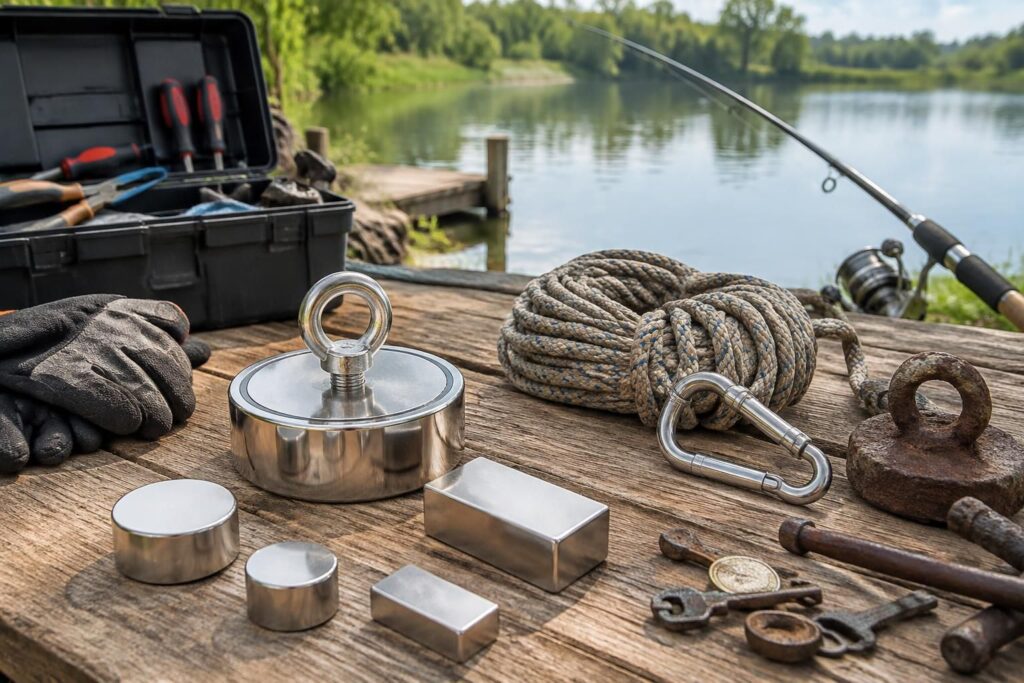
A powerful magnet can help find a screw that fell behind a piece of furniture, locate a framework in a partition wall, or retrieve metal objects at the edge of the water. But between a small DIY neodymium magnet and a fishing magnet designed for recovery, the uses, sizes, and precautions differ significantly. The right choice therefore does not depend solely on the strength indicated on the packaging: you also need to consider the shape, coating, fastening system, and type of surface or object to attract.
To buy a powerful magnet, several options exist: hardware stores, DIY chains, specialist shops, and online sales sites. However, commercial descriptions deserve careful reading because the indicated attraction force often corresponds to a measurement taken under ideal conditions. A very practical little scenario: to retrieve washers in a bin, a compact model is sufficient; to probe a riverbank, a suitable recovery magnet fixed to a reliable rope is better. Starting from the actual use, the choice becomes simpler and safer.
In brief
- For DIY: a compact neodymium magnet often suits holding small parts or detecting metal studs.
- For magnet fishing: choose a model with a robust fixing ring, appropriate rope, and coating designed for outdoor trips.
- To compare performance: check the announced force, the measured traction direction, and the test conditions.
- For purchasing: compare sizes, accessories, reviews, and return conditions with specialist or generalist sellers.
- For safe use: keep fingers, electronic devices, and people with medical devices sensitive to magnetic fields away.
Where to buy a powerful magnet for DIY or fishing
For everyday use, a DIY store allows you to see the dimensions and the fastening system before purchase. The hardware aisles often offer holding magnets, drywall magnets, or pot magnets, while a specialist magnet shop generally provides access to more sizes, shapes, and technical information.
Online, major chains and shops dedicated to magnet fishing offer a wider choice. Before ordering, check that the sheet specifies the diameter, weight, type of fastening, and announced force; for recovery models, also see if the rope or protective casing is included.
A little tip: compare the cost of the complete equipment, not just the magnet. A strong rope, a suitable carabiner, or protection can make the difference between a practical purchase and incomplete gear. To better understand the announced performance, this guide on the efficiency of a powerful magnet can supplement the comparison criteria.
Store, specialist shop or commercial website: which to prefer?
The physical store is convenient for an immediate need and to examine the finish. A specialist shop is often more relevant for a fishing magnet because advice may focus on the type of traction, the rope, and compatible accessories.
Online platforms make comparison easier, but labels like “ultra powerful” are not enough to evaluate a product. Look for measurable data and reviews describing usage close to yours; a magnet suitable for washers does not necessarily meet the demands of recovery in water.
How to choose a powerful magnet based on its use
To choose a powerful magnet, start by defining what it should attract and under what conditions. A DIY magnet often serves to hold small parts, organize tools, or locate a metal structure; a fishing magnet must remain securely attached to a rope and withstand repeated outdoor handling.
The attraction force of a magnet is generally measured in direct traction, against a thick and perfectly flat steel plate. In real life, a painted, rusty, or curved surface, or even lateral traction, reduces the effective force: the value shown is therefore not a guarantee of identical performance in all situations.
| Criterion | To verify | Intended use |
|---|---|---|
| Type of magnet | Neodymium offers strong attraction in a compact format; ferrite magnets are suitable for less demanding uses. | DIY, storage, recovery |
| Announced force | The value, traction direction, and measurement conditions must be specified. | Model comparison |
| Shape and fastening | Disk, block, pot magnet, or ring with eyelet; the fastening must match the intended action. | Holding or magnet fishing |
| Protection | A coating limits wear but does not necessarily make the magnet waterproof or rustproof. | Outdoor use and humid environments |
| Accessories | Check the rope, carabiner, casing, and usage instructions. | Recovery at the water’s edge |
For a magnetic board or light tools, there is no need to aim for maximum strength: a manageable model is often more pleasant daily. A panel project to organize family lists can also become a personalized gift, in the spirit of these personalized gift ideas for the family.
The attraction force does not tell the whole story
The indicated force varies depending on the thickness and quality of the metal, the cleanliness of the contact, and the traction orientation. For a recovery magnet, a high announced capacity can be reassuring, but it does not replace a solid fastening or a safety margin adapted to the weight and shape of the object.
Neodymium magnets are powerful for their size, but their material can break if two magnets collide or if one is dropped on a hard surface. The right reflex is to handle them slowly and store them separately, with protection when provided.
DIY magnet: useful daily criteria
In a family workshop, uses are often modest but numerous: holding a small metal part, gathering screws, or locating a stud behind a plasterboard. A compact DIY magnet, equipped with an easy grip and suitable force, avoids pulling out oversized equipment for a simple task.
To detect a metal rail in a partition wall, a magnetized tool can help locate screws or studs. However, it indicates the presence of metal, not the exact nature of the structure: move slowly, make several marks, and check before drilling, especially near cables or pipes.
For activities with children, keep powerful magnets out of reach and favor large elements securely integrated into a support. Exploration can remain playful with sufficiently large metal objects, under adult supervision, without leaving small parts accessible.
Small repairs, storage, and locating in a partition wall
To find a screw that fell behind furniture, a magnet fixed to a rod or a string can facilitate recovery, provided the object is sufficiently ferrous. To keep bits or nails within easy reach, a magnetic holder also frees up space on the workbench.
Each task requires a different shape: a disk suits holding on a flat surface, while a pot model concentrates the field towards one face and often fixes more easily. Choosing the right geometry sometimes provides more comfort than simply adding power.
Fishing magnet and magnet fishing: well equipped
Magnet fishing involves lowering a magnet attached to a rope to attract submerged ferrous objects. To start, a fishing magnet with a sturdy eyelet, reliable knot, and rope designed to support strain is a safer base than a DIY magnet simply tied to a string.
The single-sided model mainly attracts from one side, while a double-sided model can hook in different orientations. The choice depends on the gesture: casting or sliding the magnet along a riverbank does not stress the equipment in the same way.
Before an outing, inquire about local regulations and obtain any necessary authorization if a place is private or regulated. Do not handle an object that resembles ammunition, a weapon, or hazardous waste: move away, prevent others from approaching, and contact the competent authorities.
The rope and safety gestures are part of the choice
The weight recovered in the water and the resistance encountered can strongly strain the rope. Choose a quality rope, check its limits, inspect knots before each outing, and avoid wrapping it around your hand when it is taut.
A powerful magnet can suddenly pinch fingers when approaching a steel part. Also keep distance from magnetic stripe cards, certain electronic devices, and medical devices sensitive to magnetic fields; the manufacturer’s instructions remain priority.
Check quality before buying a powerful magnet
A useful product sheet indicates the material, dimensions, measured force, and usage limits. For a model intended for water, check the coating’s resistance, the presence of a suitable eyelet, and maintenance recommendations after use; moisture can promote corrosion if the protection is damaged.
Upon receipt, examine the magnet and its accessories before use. A crack, a poorly fixed ring, or a frayed rope justifies not putting the equipment into service; a quick check prevents a small defect from turning into a loss or incident.
- Occasional use: select a compact format and sufficient force for the targeted objects.
- Outdoor use: check the coating and dry the equipment carefully after each trip.
- Magnet fishing: choose a solid fastening and an appropriate rope, then check local rules.
- Online purchase: compare detailed features, included accessories, and return policies.
- Presence of children: store powerful magnets out of reach and never leave them unattended.
A successful purchase thus depends on the balance between power, manageability, and safety. The best magnet is not necessarily the most powerful: it is the one that meets the intended task, with coherent accessories and precautions.
Where to buy a powerful magnet?
A powerful magnet can be found in DIY stores, at a specialized magnet shop, or on an online sales platform. For magnet fishing, compare dedicated models and check accessories and fastening features.
What is the difference between a neodymium magnet and a fishing magnet?
Neodymium refers to a very powerful magnetic material in a compact format. A fishing magnet is equipment intended for recovery in water, often equipped with a fastening ring and chosen with a suitable rope; it can also be made of neodymium.
Is the announced attraction force guaranteed in all situations?
No. It is generally measured under ideal conditions, on a flat steel surface and with direct traction. Rust, paint, metal thickness, and lateral traction can reduce the actual force.
Which magnet to choose to start magnet fishing?
Choose a model designed for this use, with a solid eyelet and resistant rope. Read the manufacturer’s instructions, check local regulations, and never handle a suspicious or potentially dangerous object.


