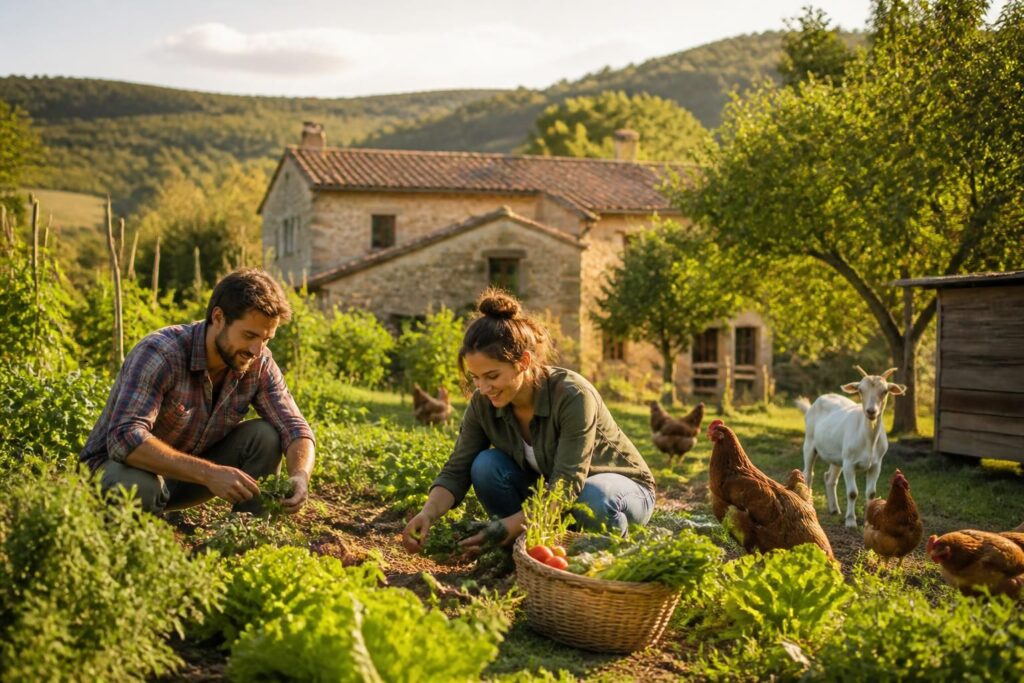
Between overflowing schedules, longer commutes, and that feeling of running without ever really getting anywhere, many city dwellers are now looking towards a simpler elsewhere. The farmer life then emerges as a very current answer: not a naive return to an idealized countryside, but a way to rediscover authenticity, a more breathable rhythm, and a more direct connection with the living world. What captivates is not just the image of a farm at sunrise; it’s the idea of a rural lifestyle where actions have meaning, where the reconnection with the earth becomes a concrete landmark, and where simplicity is far from austere. In real life, what we increasingly see are families, young professionals, or urban couples seeking to combine well-being, disconnection, and more coherent choices, sometimes without fully leaving the city.
This aspiration was not born by chance. It fits into a context where professional pressure, digital overstimulation, and mental fatigue make forms of slow life attractive, capable of bringing fresh air into daily life. The farm, whether experienced during a stay, a weekend, or a more lasting life project, crystallizes this need to return to the tangible. Between agricultural life, artisanal gestures, homemade cooking, and contact with animals, many find there a way to relearn how to live their time. A little trick I often use to illustrate this desire to slow down: as soon as an environment offers simple landmarks, clear routines, and true sensations, it reassures as much as it replenishes. This is surely where farmer life hits the mark.
In brief
- Farmer life attracts city dwellers looking for authenticity and mental breathing space.
- The need for disconnection and return to nature explains much of this enthusiasm.
- This lifestyle values simplicity, useful gestures, and a more direct daily relationship.
- The rural lifestyle also appeals through its connection with organic farming and shorter supply chains.
- The trend aligns with a pursuit of well-being, family time, and more conscious consumption.
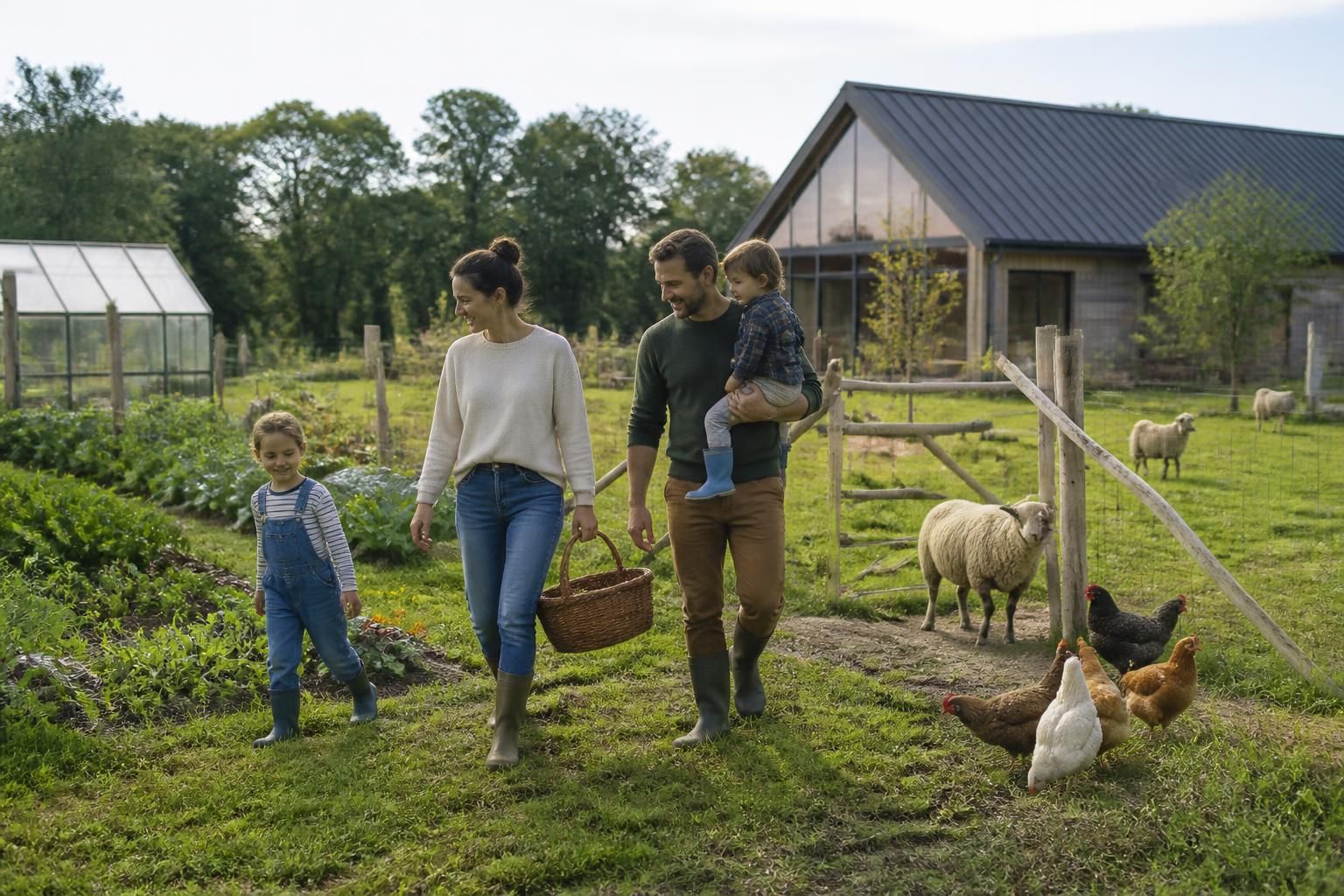
Why farmer life appeals so much to city dwellers seeking authenticity
The success of farmer life is first due to a very strong contrast with the city. When days follow one another between transportation, notifications, and emergencies, the countryside appears as a space where everything becomes clearer: we observe the light, follow the seasons, and reintroduce the body into activities. It is not mere nostalgia for “things were better before,” but a response to the exhaustion of an overly dense daily life. The return to nature acts here as a powerful counterbalance, almost like a pressure valve.
Another decisive factor: the search for a less artificial framework. Many urbanites today want to rediscover environments where people produce, repair, cook, and share. The farm embodies this movement because it shows coherence between values and actions. People readily speak of organic farming, autonomy, respect for the seasons, but also of simple gestures that re-root daily life. This explains why so many people now associate the farm with a form of discreet luxury: that of time, space, and meaning.
The need to slow down in the face of the accelerated city
In a downtown apartment, sometimes a saturated day is enough to feel tension rising. Tight schedules, screens, traffic, and constant noise end up wearing down attention. Farmer life then attracts because it offers exactly the opposite: a steadier pace, concrete tasks, and visible landmarks. It’s not inaction; it’s another way of being active.
During farm stays, many describe an immediate effect: the body relaxes, the mind calms, conversations become more present. A family that spends a few days on a dairy farm often tells the same story: children watch the animals, adults slow down effortlessly, and meals regain value. This type of experience nurtures the idea that a simpler daily life can also be richer. That is precisely what many city dwellers tired of constant acceleration seek.
A simple image that reassures and inspires
The farm also attracts because it tells an easily understandable story. From the vegetable garden to the chicken coop, from homemade cooking to durable objects, everything seems to invite coherence. This aesthetic of simplicity appeals to a generation that wants to accumulate less and choose more consciously. People don’t just buy a stay, a basket of vegetables, or a country house: they buy a feeling of alignment.
This taste for well-made things also ties in with the rise of artisanal practices, local markets, and carefully renovated houses. Agricultural life then becomes a positive imaginary, associated with hands, materials, and patience. And when a trend manages to embody beauty, usefulness, and calm all at once, it far exceeds a fad. It becomes a cultural landmark.
Farmer life and slow life: a shared desire for reconnection with the earth
The meeting between farmer life and slow life is no coincidence. Both value a finer attention to time, real needs, and quality of presence. In this context, reconnection with the earth does not only mean gardening or food production; it also refers to a more embodied way of living, where people accept the seasons, the weather, manual work, and natural cycles.
In urban families, this sensitivity often translates into small, very concrete decisions: buying local, cooking more, spending more time outdoors, choosing activities that free you from digital devices. A little trick often found in people who adopt this lifestyle: starting with a tiny habit, like a screen-free dinner, a walk to the garden, or a basket of seasonal vegetables. The change is rarely spectacular at first, but it settles in gently.
| Accelerated urban life | Farmer life and slow life |
|---|---|
| Fragmented pace, often endured | More regular and chosen tempo |
| Fast consumption, sometimes automatic | More sober and thoughtful choices |
| Relationships often caught up in urgency | More present quality time |
| High digital overload | Search for disconnection and breathing space |
| Little direct connection with nature | Return to seasons, living things, and earth |
When daily care becomes a form of ecology
Farmer life also appeals because it meets a very current concern: living better by consuming less, but better. This involves local products, durable objects, attention to waste, and sometimes a real curiosity for organic farming. At the household level, these choices change the way people shop, cook, and even occupy children.
In real life, what we see with families is that the simplest gestures often become the most unifying. Preparing a pie with seasonal fruits, going to get eggs from a producer, sorting garden seeds together: all of this creates connection. Daily life takes on a sweeter flavor, and the home becomes less a place of transit than a space for transmission. This is where the trend goes beyond aesthetics to touch experience.
What a rural lifestyle concretely changes in city dwellers’ daily lives
Adopting or approaching a rural lifestyle doesn’t necessarily mean leaving everything behind. Many start with regular getaways, a pied-à-terre, a partial remote work project, or extended weekends in the countryside. The essential thing is elsewhere: rediscovering a more conscious way of choosing activities, transportation, and priorities.
A telling example: a couple who, after several years in the city, decided to dedicate their Saturdays to the shared garden in their host village. At first, the idea seemed simple; in practice, it transformed their relationship to time. The children started observing insects, the adults rediscovered the pleasure of a useful activity, and meals gained in simplicity. This kind of experience shows well that farmer life is not just a setting, but a change in posture.
Visible benefits on well-being and family life
The first effect often observed concerns overall well-being. Less noise, fewer solicitations, more natural movement: the body handles daily life better. Sleep improves, tensions decrease, and the feeling of having a “full head” gradually diminishes.
Families also find a favorable ground here to create simple rituals. Morning walks, picking, cooking together, caring for animals, quiet reading: these moments are nothing extraordinary, but they structure the day and secure children. In childhood’s universe, this type of framework often helps soothe relationships. A clearer environment means less need to run after everything.
Consumption changes that go in the same direction
Farmer life also influences the way people shop. City dwellers who take inspiration from it more willingly prioritize quality over quantity, solid objects, second hand, and local producers. The choice of more seasonal, sometimes more plant-based food often fits this logic. The goal is not perfection but sustainable balance.
For families who enjoy farm-related activities without necessarily living in the countryside, some digital leisure can even extend this imagination in a playful way. Agricultural simulation games like the best mods for Farming Simulator 22 or highly addictive Farming games on Switch allow, in their own way, to discover rural daily gestures. Of course, it remains a virtual world, but it also reveals a genuine cultural interest in the earth, machines, and farm management.
The simplest entry points to test farmer life without turning everything upside down
There is no need to move immediately to taste this trend. Many city dwellers start with accessible experiences, often very effective for seeing if the rhythm suits them. The most important thing is to move forward without pressure, testing what truly soothes and what, on the contrary, adds unnecessary mental load.
Here are some easy paths to try, adapted according to age and energy levels:
- Spend a day at an educational farm to reconnect with animals and the seasons.
- Choose a farmers’ market and then cook a simple meal at home.
- Book a weekend in a rural cottage to experience disconnection.
- Create a mini vegetable garden on a balcony or windowsill to experiment with reconnection with the earth.
- Replace a very stimulating outing with a slow walk in a natural environment.
This gradual approach often works better than a big turn. A family can, for example, start with a nature workshop, then choose a more rural destination for vacations. To prolong this atmosphere at home, simple creative activities can also help children imagine this gentler life, like a farm model or a countryside scene to color, for example with house coloring ideas. The gesture matters as much as the result.
Limits to keep in mind for a realistic return to nature
The charm of farmer life should not mask the reality of agricultural work and life outside big cities. Days can be long, seasons demanding, and organization much more constraining than it looks in inspiring images. It is precisely this contrast that fascinates: the dream of freedom sometimes clashes with the need for discipline.
We must also distinguish the rural aesthetic from a genuine commitment to agricultural life. Living in the countryside, consuming locally, or doing remote work near fields does not equate to working as a farmer. This distinction is essential to avoid fantasy and maintain a clear perspective. The lifestyle is all the more appealing because it remains possible at several levels, from occasional stays to full relocation.
An imaginary that must remain anchored in reality
The strength of this trend lies precisely in its ability to make people dream while encouraging them to act. City dwellers do not just seek boots and a beautiful wooden terrace: they want a life that is more aligned, more breathable, and more useful. Farmer life then becomes a powerful symbol of what many hope for in 2026 and beyond: less saturation, more attention, and a deeper connection with the tangible world.
Subtly, this movement reminds us that a peaceful daily life is not built solely by changing scenery. It is also born from repetitive choices, modest gestures, and a gentler relationship to what truly matters. That is probably why this way of living continues to attract, well beyond passing fads.
Is farmer life just an aesthetic trend?
No. While the rural image plays a role, the attraction mainly comes from a real need to slow down, find meaning, and live with more simplicity every day.
Can this spirit be adopted without leaving the city?
Yes, absolutely. Habits like cooking local food, reducing screen time, going to the market, or spending more time outside already allow people to feel the effects.
Why is well-being often discussed in this topic?
Because the return to nature, disconnection, and gentler pace often promote better sleep, less stress, and an overall sense of calm.
Is farmer life compatible with an ecological approach?
Yes, because it often encourages local consumption, waste reduction, durable products, and more seasonal food, sometimes close to organic farming.
How to test this lifestyle before going further?
The simplest way is to start with a weekend in the countryside, an educational farm, a farmers’ market, or some home rituals inspired by slow life.