Contenu sponsorisé · Cet article contient des liens commerciaux.
With the rise in popularity of volleyball, many people wish to get started with this dynamic and friendly sport. Understanding its essential rules is the first step to fully enjoying the game, whether you are a beginner or simply curious. On a court measuring 18 meters by 9, two teams of six players each compete by exchanging the ball over a net whose height varies according to the gender of the female and male players. The objective is simple and captivating: score points by making the ball fall into the opponent’s court or causing a fault, while respecting a precise rotation and appropriate technical moves. Matches are played in three sets, or five in case of a tie, with exciting moments where every serve, attack, or block counts towards the final score. This accessible practice, which requires coordination, communication, and team spirit, is a true source of motivation and enjoyment for all those who take it up.
In brief:
– Volleyball pits two teams of 6 players on an 18×9 m court, with a net adjusted to 2.24 m for women and 2.43 m for men.
– Matches are contested over 3 winning sets, with a fifth set to 15 points in case of a tie.
– Player rotation at each won serve encourages versatility and collective strategy.
– Essential moves to master include the pass, the forearm pass, and a simple “underhand” serve to start well.
– Respecting the rules allows smooth play: watch not to touch the net, avoid carried balls, and control rotation.
– Ongoing communication between teammates optimizes coordination and safety on the court.
The basics of volleyball: understanding the court, teams, and match flow
On a rectangle 18 meters long and 9 meters wide, volleyball is played between two teams of six players. The net, a thin separating element, rises to 2.43 meters for men and 2.24 meters for women, dimensions strictly defined for each competition. It is behind the end line that each serve begins, a crucial move that starts the rally and can destabilize the opponent. Games generally take place over three winning sets, or five if suspense builds with a tie. Each set ends when a team reaches 25 points, with a minimum lead of two points, except for the last set limited to 15 points. This game mechanism operates like a rhythm where every point counts, favoring endurance as much as concentration. The execution of precise rotations between players promotes versatility and prevents monopolies.
The central role of rotation and service management
Rotation is triggered as soon as the receiving team wins the right to serve. Each player moves one position clockwise, ensuring that everyone experiences offensive and defensive positions in turn. This rule often causes faults for novices who forget to alternate their place. The serve must be performed behind the end line, with the peculiarity of being allowed even if the ball touches the net — as long as it passes over it. Learning this move, such as the “underhand” serve recommended for beginners, is the key to gradually gaining confidence. Do not neglect: avoiding the net fault, which occurs as soon as a player contacts the net during an action. This infraction is penalized and automatically awards a point to the opponent.
Fundamental moves for progressing confidently on the court
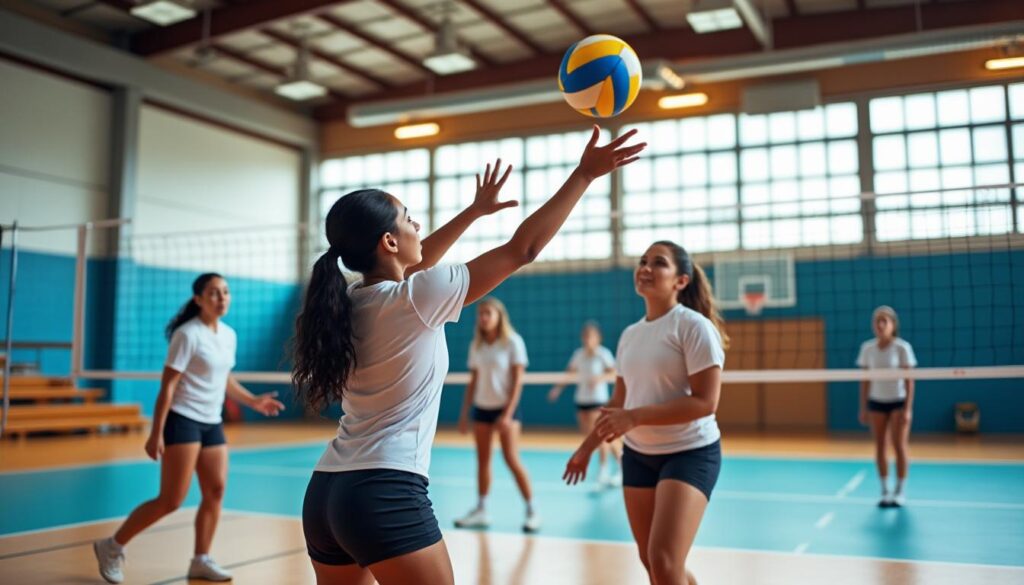
Volleyball practice often begins with acquiring three simple and effective moves: the pass, the forearm pass, and the approachable serve. These basic movements, less intimidating than spectacular smashes, are within everyone’s reach and essential to the fluidity of the game. The pass, performed by keeping the arms above the head with fingers well spread, allows directing the ball to a teammate, involving coordinated work between legs and arms. Often a source of beautiful team connections, it structures the match’s tempo. The forearm pass is a defensive move used to receive low balls and serves. Joining the forearms, forming a flat surface, then hitting the ball without holding it takes some training but quickly becomes automatic. Finally, the underhand serve — easier to master for novices — consists of tossing the ball slightly in front, then gently hitting it from below, ensuring a suitable trajectory over the net.
Exercises to start gently and have fun
Here are four exercise ideas to prepare in 5 minutes to get familiar with volleyball without pressure:
- Wall passes to improve accuracy and control.
- Forearm passes with a softer ball to limit minor impacts and gain confidence.
- “Underhand” serves aiming to make the ball pass over the net on each attempt.
- Mini-rotational matches, to integrate the rules smoothly and develop team fluidity.
A little tip often appreciated is to film yourself during these trainings: by observing your moves, it becomes much easier to correct mistakes and refine your techniques.
Understanding key rules to avoid common faults
Despite the apparent simplicity, several mistakes frequently creep in among beginners, slowing their progress and sometimes detracting from the enjoyment of the game. Among the most common, contact with the net is the most well-known serious fault, penalized instantly. Similarly, failing to respect the rotation results in an immediate point awarded to the opposing team. Another trap: the carried ball, which occurs when the ball is held longer than regulations allow, disrupting the rhythm of play and destabilizing the partner team. Finally, the discipline requires that attacks from the back row be executed at the right moment, a strategic detail often unknown to novices. Knowledge and respect for these rules help each player evolve in a pleasant and safe environment.
| Element | Simplified Explanation |
|---|---|
| Number of players | 6 per team |
| Max touches | 3 maximum contacts per team, no consecutive double touch by the same player |
| Service | Must be performed behind the end line, ball allowed to touch the net |
| Match duration | 3 winning sets, up to 5 if tied |
| Rotation | Clockwise every time the service is recovered |
The libero’s role in defense and reception
At the heart of defensive strategy, the libero is a specialized player, recognizable by their distinctive jersey. Mainly responsible for receiving serves and defending, they cannot serve or attack, but their presence is a key asset to stabilize the backline and counterbalance opponent attacks. Their speed and precise moves often tip the balance in favor of their team. Appreciating the libero’s role also helps beginners better understand task distribution within a team, thereby fostering better collective communication.
Tips for progressing quickly while having fun
Consistency is the key to improvement. Rather than long spaced sessions, a few minutes of frequent practice through adapted exercises will quickly improve ball control and necessary reflexes. Communication among teammates is also a pillar: clearly announcing intentions (“I’m going!”, “Left!”, “Leave it!”) creates a safe and fluid environment, avoiding collisions and misunderstandings while developing cohesion. Finally, don’t hesitate to multiply learning sources, notably through freely accessible video tutorials on Sikana.tv or YouTube, offering progressive programs at your fingertips.
| Platform | Type of Content | Useful Link |
|---|---|---|
| Sikana | Progressive technical tutorials | sikana.tv |
| YouTube (Playlist) | Practical exercises for beginners | youtube.com/playlist |
| Decathlon Conseil | Educational articles and illustrated videos | decathlon.fr/volley |
How many players make up a volleyball team?
Each team is composed of six players on the court, promoting a balanced dynamic between offense and defense.
What is the official height of the volleyball net?
For men, the standard net height is 2.43 meters and for women, 2.24 meters in accordance with international standards.
What are the most common faults to avoid when starting out?
Touching the net, not respecting rotation, carrying the ball, or attacks from the back row at the wrong moment are the most common errors.
What role does the libero play on the court?
The libero is a defensive specialist, responsible for receiving serves and reinforcing the backline, but cannot serve or attack.
How to progress quickly in volleyball?
Training regularly, communicating with the team, using educational video resources, and practicing basic moves contribute to effective progress.