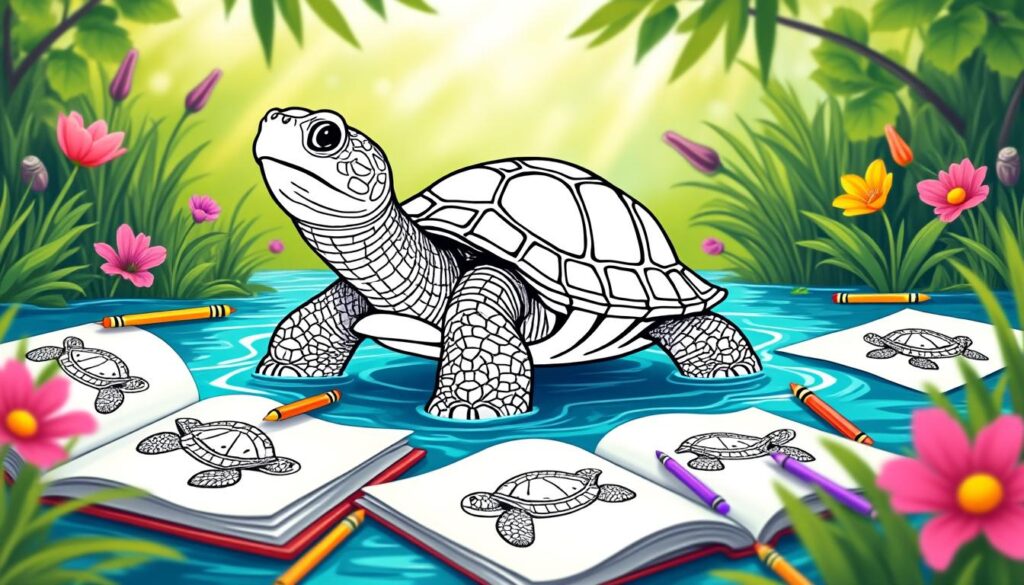
Coloring a turtle is not just a creative leisure activity: it is an open door to discovering nature and an artistic awakening exercise accessible to all children. These drawings, simple or detailed, offer a playful and calming moment that promotes fine motor skills mastery while stimulating creativity and imagination. Whether at home, at school, or while traveling, these printable pages provide an opportunity to immerse oneself in the fascinating world of turtles, between land and sea, while developing at one’s own pace. Moreover, they encourage a gentle approach to learning where observing, understanding, and expressing intertwine around a craft activity as enjoyable as it is enriching.
In brief:
- Fun and relaxing activity: turtle coloring captures children’s attention and soothes them, while stimulating their creativity.
- Development of motor skills: handling pencils and markers helps refine gesture precision and coordination.
- Easy integration: these printable pages adapt to educational needs, whether in class, at home, or in creative workshops.
- Educational exploration: through the unique shapes and patterns of turtles, children learn to observe and name natural elements.
- Free and accessible: a cost-effective creative hobby suitable for all ages, from preschool to elementary school.
Turtle coloring pages to awaken children’s curiosity and creativity
Observing a turtle and having fun coloring it represents much more than just a simple drawing to fill in. Turtles, with their calm energy and decorated shell, offer a source of inspiration that awakens the sense of observation and invites patience. Between the softness of their gait and the graphic richness of the plates composing their natural armor, children discover a world conducive to artistic freedom and learning. In a context where concentration is essential to succeed at this activity, coloring provides a safe space that encourages the child to go at their own pace, explore color palettes, and even invent original patterns.
Learning to color a turtle with simple and accessible tips
To support budding young artists, some practical advice increases satisfaction and the quality of coloring:
- Respect the shapes of the shell by following the lines of the plates, which give the turtle its distinctive appearance.
- Play with shades: coloring the center of the plates often darker and lightening towards the edges helps add volume.
- Apply a light touch on the skin to highlight the small scales without masking the details.
- Add subtle shadows beneath the shell and around the limbs, with slightly darker tones, to enhance realism.
- Illuminate the eyes by keeping a small white dot, which gives life and softness to the gaze.
This practical advice allows each child, regardless of age and level, to progress while having fun.
Creative ideas to extend the enjoyment of turtle coloring
Is coloring just one step? Not necessarily! This activity lends itself to many manual extensions that grow the imagination and strengthen fine motor skills:
- Create a 3D shell by folding accordion paper and gluing it onto the colored turtle for an original and tactile effect.
- Make a turtle with fingerprint art: small decorative dots painted on the shell awaken precision and artistic sense.
- Compose a colorful mobile with several cut-out and suspended turtles, ideal for a group workshop in class.
These activities encourage teamwork, hand-eye coordination, and make it possible to exploit the graphic richness of the original drawing, while giving new meaning to this drawing exercise.
Recommended natural color chart for realistic turtle coloring
| Part of the turtle | Suggested color | Explanation |
|---|---|---|
| Shell (base) | Olive brown | Gives a natural and soft shade, close to the natural environment. |
| Shell (darker plates) | Dark brown | Enhances the relief of the plates and provides contrast. |
| Shell (highlights/edges) | Sand beige | Adds light and realism to the contours. |
| Skin (head and legs) | Gray green | Reproduces the particular texture of the scales. |
| Skin shadows | Dark olive gray | Highlights the volumes with more subtle shades. |
| Belly (plastron) | Beige yellow | Soft color to underline the difference from the back. |
| Eyes | Black with a small white dot | Makes the gaze lively and expressive. |
Connections between turtle coloring and fundamental learning
Beyond being a harmonious manual activity, turtle coloring calls upon several fundamental skills:
- Fine motor skills, which develop through following lines and contours.
- Color recognition and their shades.
- Concentration, finalized by patience and time management.
- Attentive observation of shapes, textures, and details specific to turtles.
- Creativity, encouraged by personal choices of colors and patterns to personalize each drawing.
In real life, what I see with children shows how much these quiet times favor a flexible association between learning and pleasure. The slowness of the turtle also provides a beautiful example of patience and gentle progress, a philosophical reflection appreciated by the youngest.
Additional resources to enrich your activities
To extend these moments, why not offer funny or poetic stories about turtles? Childish jokes that play on their slow and peaceful nature stimulate language and bonding around this activity. You will find a suitable selection online that will trigger laughter and warm exchanges between children and adults, a precious addition to vary creative and verbal pleasures.
Children’s jokes for laughing together
Turtle coloring offers welcome relaxation combining imagination and scientific discovery. The child, immersing themselves in this universe, develops multiple skills while cultivating their own artistic sensitivity in a simple and accessible moment.
Are these turtle coloring pages free?
Yes, all the turtle coloring pages mentioned here are downloadable and printable for free. They are perfectly suitable for family or school use.
From what age can children enjoy these drawings?
The models cover a wide age range, from toddlers to elementary school children, with levels of detail adapting to each stage of development.
Which tools should be preferred for neat coloring?
Thicker paper (such as cardboard paper), colored pencils for soft textures, markers for bright colors, avoiding too much pressure on the turtle’s skin.
Can these coloring pages be used in class?
Yes, these coloring pages are perfect for school use, especially in preschools and elementary schools, in individual or group activities.
What is the educational benefit of turtle coloring?
It develops motor skills, color recognition, concentration, observation, and creativity, while introducing a playful knowledge of animals.


