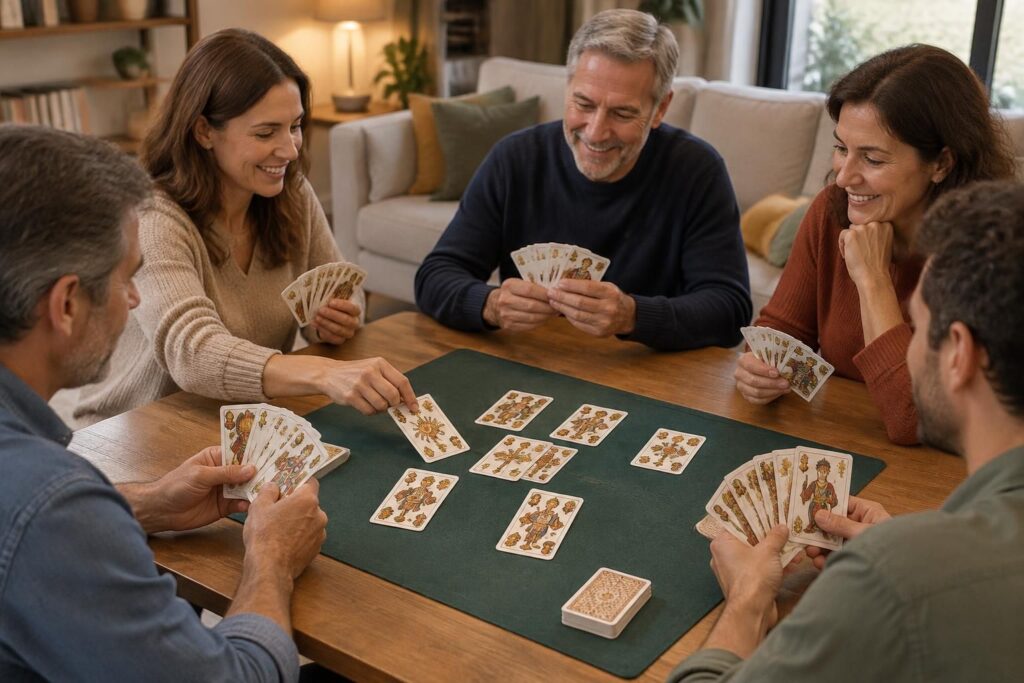
Tarot is easier to learn when starting with a simple question: how many people are around the table? With three, four, or five players, dealing the cards, bidding, and roles change slightly. With two, it is better to choose a training variant, because classic French tarot is played with three to five players. Once these reference points are set, the rules of tarot become more accessible: each player receives their cards, announces a contract, then tries to win the necessary tricks.
For a first game, there is no need to remember everything at once. It is enough to understand the value of the cards, to spot the three bouts — the Petit, the 21, and the Excuse — and to follow the course of a game in the correct order. Like around a family board game, a round with explanations often works better than a long reading of rules: the cards quickly tell their logic. Here are concrete reference points to set up an easy tarot game, whether there are two or five players at the table.
In brief: tarot rules according to the number of players
- With 3 players, each receives 24 cards and the dog counts 6 cards.
- With 4 players, each receives 18 cards and the dog counts 6: this is the most common setup.
- With 5 players, each receives 15 cards and the dog counts 3; the taker calls a king to designate their partner.
- With 2 players, there is no universal classic configuration: a variant with a dummy hand allows training.
- A deal always follows the main steps: dealing, tarot bids, possible discard, tricks, then counting points and contracts.
The simplest advice: start by playing some face-up tricks, then add bidding and scoring once everyone feels ready.
Tarot rules for 3, 4, or 5 players
French tarot is played with 78 cards: 56 cards divided into four suits, 21 trump cards numbered, and the Excuse. Trumps are used to trump or overtrump, while face cards and some trumps bring points. The Petit, the 21, and the Excuse are called the bouts; their number in the taker’s tricks determines the threshold to reach.
Before dealing, choose a dealer and have the deck cut. The cards are then dealt in small packs, counterclockwise, respecting the number of players. The dog — the cards set aside — varies according to the setup and comes into play after the bids.
| Players | Cards per person | Cards in the dog | Particularity |
|---|---|---|---|
| 3 | 24 | 6 | One taker plays against two defenders |
| 4 | 18 | 6 | One taker plays against three defenders |
| 5 | 15 | 3 | The taker calls a king to form a team |
With five, the player holding the called king becomes the taker’s partner, without revealing their role immediately. If the taker holds all four kings, they may call another face according to the rules agreed upon before the game. This small particularity turns the round into a game of observation: the tricks give clues about alliances.
Dealing the cards and the progress of a game
After dealing the cards, each player examines their hand and evaluates their chances. Tarot bidding starts with the player after the dealer and continues until everyone passes or announces a contract. The bids, from the lowest to the highest, are generally: prise, garde, garde sans le chien, and garde contre le chien.
The player winning the bids becomes the taker. In prise or garde, they turn over the dog, add it to their hand, then discard the same number of cards face down; this discard cannot contain bouts or kings. In garde sans, the dog returns to the taker at the end of the round; in garde contre, it counts for the defense. The precise rules for discarding deserve to be recalled before the first deal.
The player who starts lays down a card, then the others follow suit if they can. Without this suit, they must trump with a trump card if possible; if a trump has already been played, they overtrump if they can. The trick goes to the highest card of the requested suit or the highest trump played: its winner leads the next trick.
- Deal the cards and set the dog aside.
- Bid to designate the taker and fix the contract.
- Play the tricks respecting suit, trump, and overtrump.
- Count the points and check if the contract is successful.
A little tip to start: keep the three bouts visible and announce aloud the requested suit at each trick. This avoids forgetfulness and helps everyone follow the round without making the game feel like a test.
Bidding in tarot: choosing a contract suited to your hand
A bid commits the taker to reach a certain number of points. A hand rich in trumps, with several bouts or well-distributed face cards, may justify a bolder announcement; a weak hand rather invites passing. For a first game, it is better to announce cautiously: learning to read your hand matters more than trying a difficult contract right away.
The dog can strengthen the taker’s hand, but it must not be seen as a promise of success. It can bring trumps or face cards, but also cards that force you to revise your plan. With five players, calling a king adds a deduction element: the partner can stay discreet until a played card reveals their side.
Contracts have different coefficients for the final calculation: prise × 1, garde × 2, garde sans × 4, and garde contre × 6. The chosen contract does not change the number of points to reach but amplifies the result, positively or negatively. A thoughtful announcement thus makes the game more enjoyable and limits unpleasant surprises.
Points and contracts: counting without complicating the game
In tarot, the total of the cards represents 91 points. The taker must reach a threshold that depends on the number of bouts won in their tricks: 56 points without bouts, 51 with one bout, 41 with two bouts, and 36 with three bouts. Points for cards are counted in pairs: a bout or a king with a small card is worth 5 points, a queen with a small card 4, a knight 3, and a jack 2.
For example, if the taker has two bouts at the end, they must reach 41 points. If they have collected 43, the contract succeeds by 2 points; if they only get 39, they fail by 2. The final score then takes into account this difference, a base of 25 points, and the contract coefficient. For the first games, one player can keep the score while the others watch the tricks.
A reassuring way to progress is to play a first round without calculating the complete score: only count the taker’s tricks and bouts. Once this step runs smoothly, add the card values, then the coefficient. The game thus becomes clearer without losing its pace.
Tarot with 2 players: a variant for training
Tarot with 2 players is not a standard configuration of French tarot, whose usual rules provide for three to five participants. To still play with two, you can try an initiation variant with a third dummy hand: deal three hands of 24 cards, then leave the dummy hand face down at the start.
First play as in a three-player game, keeping in mind that only one player controls a hand and that the variant is less balanced than a classic game. For an even simpler introduction, reveal the dummy hand after the bidding and use it as support to practice following suits, spotting trumps, and understanding tricks. Agree on how to handle the dog and the scoring before starting, as these points vary according to home rules.
This setup works mainly as a discovery workshop, not as a fair measure of skill. If the goal is to compare scores or play according to usual customs, it’s better to wait for a third person; with two, the essential thing is to become familiar with the cards.
Easy tarot game: reference points for a first game
In a first round, the rules are easier to remember when they are announced at the moment they apply. Before the game, recall the bids; at the first trick, specify that the suit must be followed; at the first trump, explain the role of trumps. A game thus accompanies players step by step, without overwhelming them with exceptions.
- Start with four players if possible: this setup is very common and makes roles simple to understand.
- Play a practice round without stakes, calmly commenting on decisions.
- Keep a memo with the number of cards, bout thresholds, and the order of bids.
- Agree on variants, especially for the Excuse and the calls in five-player games.
In real life, a table of beginners often benefits from slowing down rather than trying to play fast. When players know why they follow a suit or trump, habits come naturally — and the exchanges around the cards are part of the pleasure.
Common mistakes to avoid in tarot
The most frequent confusion is forgetting to follow suit while having it. Another mistake is believing the Excuse automatically wins a trick: it mainly serves as a special card and follows specific rules of return or conservation, which must be agreed upon depending on when it is played.
With five, the called king must not be announced aloud by its holder: the interest of this setup lies precisely in observation. By clarifying these few rules before dealing, beginners can focus on strategy rather than misunderstandings.
Practical questions about tarot rules
How many cards does each player receive in tarot?
With three players, each receives 24 cards; with four, 18; with five, 15. The number of cards in the dog is respectively 6, 6, and 3.
How many bouts are needed to succeed in a tarot contract?
The threshold depends on the number of bouts in the taker’s tricks: 56 points without bouts, 51 with one bout, 41 with two bouts, and 36 with three bouts.
Is tarot with 2 players played according to classic rules?
No. The classic rules of French tarot provide for three to five players. With two, it is possible to use a home variant with a dummy hand, agreeing beforehand on the dog and counting.
Which configuration should one choose to learn tarot?
With four players, the roles are easy to visualize: one taker plays against three defenders. A trial round, with the rules explained through the tricks, allows gradual learning.


