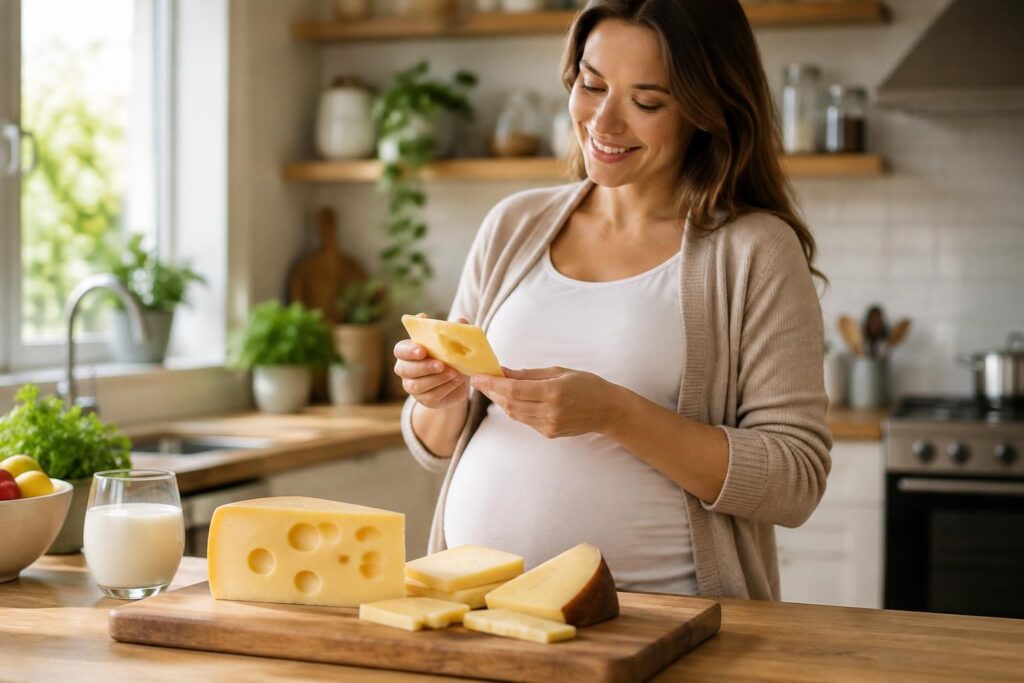
When a pregnancy begins, questions about cheese often arise at the most ordinary moment: in front of the refrigerator, a slice of emmental in hand. Good news, emmental during pregnancy is generally compatible with a cautious diet, as it belongs to cooked pressed cheeses. Its low-moisture texture and production reduce risks, but some habits remain useful: choose a well-preserved product, check its packaging, and remove the rind.
To sort through cheeses allowed during pregnancy, the type of cheese, the milk used, and storage conditions matter more than the name alone. Raw milk does not automatically lead to the same recommendation for all cheeses: some cooked pressed cheeses are considered lower risk, while several fresh or soft cheeses require more caution. Camille, five months pregnant, can thus keep her emmental for a homemade sandwich, while carefully checking the other products on her platter. The goal is not to eliminate all pleasure, but to choose with simple and reassuring guidelines.
- Emmental is generally allowed, including when it is made from raw milk, as it is a cooked pressed cheese.
- Remove the rind and favor a packaged product, well refrigerated and consumed within the appropriate time frame.
- Avoid raw milk cheeses that are not cooked pressed cheeses, as well as certain soft cheeses with bloomy or washed rinds.
- In a hot dish, heat the cheese through and respect storage rules.
Emmental during pregnancy: a generally allowed cheese
Emmental is part of the cooked pressed cheeses, like comté or gruyère. The cooking of the curd and aging results in a firm and low-moisture texture, creating an environment less favorable to the multiplication of certain bacteria than fresh or very moist cheeses.
The answer to “emmental during pregnancy, yes or no?” is therefore generally yes, even if the label indicates “raw milk.” To limit contamination after production, prefer a wrapped piece or a freshly cut portion with clean utensils, remove the rind, and promptly return the cheese to the refrigerator.
Raw milk emmental and listeriosis risk during pregnancy
The mention “raw milk” deserves attention, but it is not enough to classify all cheeses the same way. For emmental, the cooked pressed family is an important criterion: recommendations distinguish these cheeses from many soft raw milk cheeses which are more sensitive to contamination.
The listeriosis risk during pregnancy nonetheless justifies simple actions: keep emmental cold, respect the indicated date, avoid products with damaged packaging, and do not keep an opened portion for long. The rind may be more exposed to handling; removing it is an easy precaution to apply.
Cheeses allowed during pregnancy: guidelines for choosing
To identify cheeses allowed during pregnancy, first look at the texture and manufacturing process, then the label. A pasteurized cheese is made from heated milk to reduce microbes, but pasteurization does not exempt you from checking storage or following instructions related to some soft cheeses.
| Type of cheese | Guideline during pregnancy | Useful precaution |
|---|---|---|
| Emmental, comté, gruyère | Generally allowed, including if made from raw milk | Remove the rind and keep refrigerated |
| Fresh cheese made from pasteurized milk | Generally possible | Choose an intact packaging and respect the expiry date |
| Soft cheese with bloomy or washed rind | To avoid as a precaution, even if pasteurized | Do not consume cold during pregnancy |
| Raw milk cheese not cooked pressed | To avoid | Complete cooking in a dish can reduce the risk |
| Blue cheese or veined cheese | To avoid cold as a precaution | Choose it only in a preparation heated through |
The category “pasteurized cheese during pregnancy” is often reassuring, but it does not make all varieties equally safe. Soft cheeses with bloomy or washed rind are generally discouraged, while a fresh pasteurized cheese, properly stored, may be suitable. For special situations or specific medical advice, the professional following the pregnancy remains the right contact.
Raw milk cheese during pregnancy: which ones to avoid?
Raw milk cheese during pregnancy calls for a useful distinction: it is better to avoid raw milk cheeses that are not cooked pressed, notably certain fresh and soft cheeses. Cheeses with bloomy or washed rinds, like reblochon, are among the products for which caution is recommended.
A raclette or tartiflette is not automatically safe because the cheese has simply melted. It must be heated sufficiently and evenly through; to know how to adapt these dishes, consult advice on reblochon during pregnancy and tartiflette during pregnancy.
Cheese consumption during pregnancy: good daily habits
Cheese consumption during pregnancy can remain varied with some habits easy to incorporate into the routine. Camille, for example, keeps a clean box for opened portions, notes the opening date, and avoids leaving the platter on the table throughout the meal.
- Read the label: identify the type of milk and family of cheese, without relying solely on the commercial name.
- Respect the cold: put the product back in the refrigerator after serving and follow storage instructions.
- Avoid cut products left for long at room temperature and portions with unusual appearance or smell.
- Remove the rind, especially for emmental and other cooked pressed cheeses.
- For a hot dish, heat through: the cheese must be hot throughout its thickness, not just melted on the surface.
These precautions fit into a global approach to pregnancy and nutrition: it is not about living each meal with worry, but about reducing avoidable risks. Food safety during pregnancy mainly depends on well-chosen products, a respected cold chain, and clean cooking.
Cheeses to avoid during pregnancy: main categories
Cheeses to avoid during pregnancy are mainly those with higher contamination risks and consumed cold: raw milk cheeses other than cooked pressed ones, soft cheeses with bloomy or washed rinds, and blue cheeses. The issue is not a certainty of contamination, but a precaution adapted to a period where listeriosis can have serious consequences.
A cheese incorporated in a recipe can be consumed if the preparation is heated through. This concerns, for example, a well-cooked sauce or gratin: a merely lukewarm garnish or slightly softened cheese does not provide the same guarantee. In case of doubt about a product or after a concerning consumption, it is better to seek advice from a midwife or doctor.
Can you eat emmental during pregnancy if it is raw milk?
Yes, emmental is a cooked pressed cheese, generally considered allowed during pregnancy, even when made from raw milk. Remove its rind, check its preservation, and respect the indicated date.
Is grated emmental in a bag allowed during pregnancy?
It can be consumed if the packaging is intact, the product is kept refrigerated, and the expiry date is respected. Carefully reseal the bag after opening and consume it quickly according to the manufacturer’s instructions.
Is pasteurized cheese always risk-free during pregnancy?
Pasteurization reduces certain risks, but it is not sufficient alone: the type of cheese, storage conditions, and handling also matter. Soft cheeses with bloomy or washed rinds are generally discouraged as a precaution.
Can a cheese to avoid be eaten in a hot dish?
Complete and homogeneous cooking through can reduce the risk linked to bacteria. Simply melted or lukewarm cheese does not offer the same assurance; make sure the entire preparation is well heated.