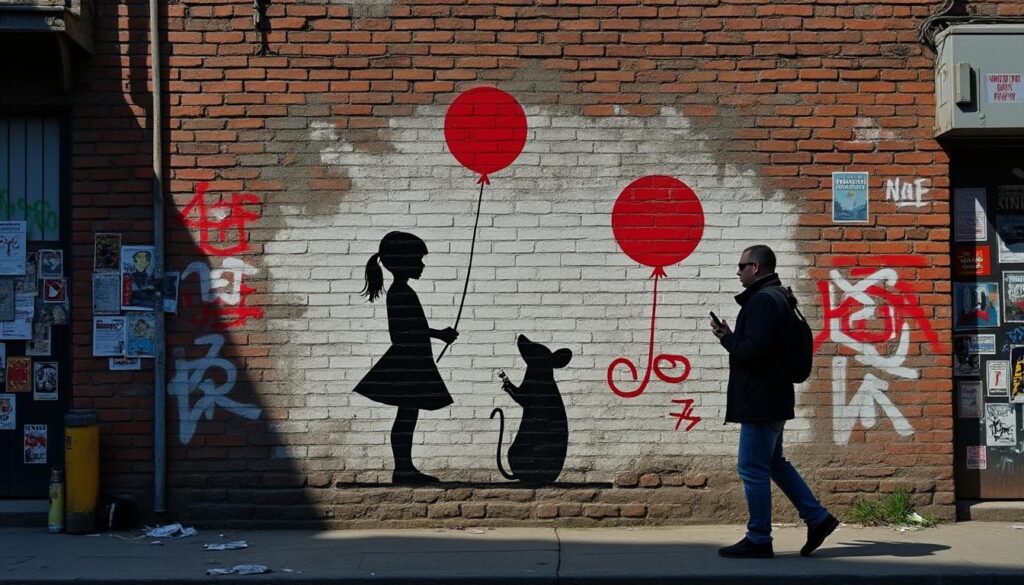
Banksy undoubtedly embodies one of the most enigmatic and fascinating figures of contemporary street art. Through a style recognizable from a thousand miles away, he blends poetry, provocation, and political activism to challenge passersby and shake up the codes of the art world. In urban art, where anonymity is often a necessary choice, Banksy stands out with a confident technique: stenciling, which allows him to quickly mark walls around the world without sacrificing precision and visual impact. This approach is not limited to mere aesthetic or protest claims but offers a genuine reflection on society, power, war, and capitalism.
In a context where street art constantly oscillates between creative act and vandalism, Banksy is an undisputed master, blurring the boundaries between street art and contemporary art. His anonymity helps make him a living legend, while his works, often ephemeral, question the relationship between public space and private sphere. In 2025, as his works continue to fuel debates, several exhibitions and solidarity initiatives have enabled a wide audience to discover this captivating universe, making Banksy accessible to all, from galleries to sidewalks.
Banksy: an artist of shadow and committed stencil
A British artist from Bristol, Banksy uses stenciling, a technique that allows him to intervene quickly in public spaces. This precise and efficient process is perfect for an artist seeking to maintain anonymity while delivering a strong message. His graffiti are not simple decorative images; they delve into activism by using provocation as a lever. Whether denouncing war, consumerism, or social injustices, Banksy places politics at the center of his works.
This constant tension between urban art and activism explains why his work is sometimes seen as subversive, often provoking mixed reactions. In real life, what one observes is that his murals have the power to bring people together, spark dialogue, and awaken consciences in varied environments, from London to Paris, passing through New York or Tel Aviv.
The power of stencils: speed and impact
Stencil is at the heart of Banksy’s technical approach. This method allows him to apply complex images in a reduced time, an essential asset for an artist who often must act discreetly. Moreover, the simplicity of shapes and the marked contrast of his lines reinforce the message and memorability of the work.
These characteristics make stenciling a great entry point, which can even be experimented with as a family activity with children during creative sessions to prepare in 5 minutes flat, adaptable to all ages and energies of the day.
A graffiti between art and social protest
Street art, as practiced by Banksy, has long been a subject of debate: art or vandalism? This ambiguity is all the more sensitive because the works appear in public places, sometimes without permission. Yet their visual power and political messages confer upon them an undeniable artistic value.
As a true mirror of society, Banksy fits into the graffiti tradition as an act of revolt. His works play with street art codes to challenge capitalism, war, and even the mechanisms of power. This makes each of his creations a visual and powerful manifesto.
Some recurring themes of Banksy
- Politics and power: harsh criticism of leaders and unjust systems.
- War and peace: denunciation of armed conflicts, often with direct reference to current events.
- Consumption and capitalism: a often ironic look at consumer society and its excesses.
- Freedom and anonymity: his own anonymity highlights the fight for freedom of expression.
- Environment and humanity: warnings about ecological degradation and human relations.
Exhibitions, controversies, and mystery: Banksy in the official world of contemporary art
Despite refusing to show himself, Banksy has seen his works enter museums and gallery walls, blurring the lines between raw urban art and the contemporary art market. This official recognition is not without conflicts: unauthorized exhibitions sometimes exploit his name for commercial purposes, while works are stolen shortly after appearing on walls.
This paradox between popularity and rejection of the system is one of the major enigmas surrounding Banksy. The famous case of “Girl with Balloon,” whose work partially self-destructed during an auction in 2018, illustrates well this tension between criticism of the art market and active participation in its functioning.
| Notable Events | Date | Impact |
|---|---|---|
| “Girl with Balloon” destroyed live at Sotheby’s | 2018 | Strong critique of the art market, worldwide craze |
| Free and solidarity Banksy exhibition in Montpellier | 2025 | Wide public access, demonstration of the solidarity aspect |
| Work stolen then found in London | 2024 | Reveals the value and fragility of urban works |
In real life, what often surprises urban art enthusiasts is this ability to blend poetry and provocation with incredible fluidity. Every Banksy work strikes a double chord: that of deep meaning and that of the question posed to the passerby.
Urban art challenged: between recognition and citizen movements
Street art continues to evolve, and Banksy is one of the major players. While some fear that this type of art “loses its soul” due to media exposure and commercialization, there is simultaneously a revival with the feminization of messages and a repoliticization of works.
This perpetual tension preserves the vitality of urban art in 2026 while prompting reflection on questions of legitimacy and place in public space. Banksy, through his artistic activism, offers a careful listening to this changing world. It invites everyone, even the youngest, to question their environment in a creative and committed way.
- Feminization of messages: more female artists emerging in street art.
- Repoliticization: more engaged messages with a focus on global crises.
- Dialogue with the population: urban art as a social and educational tool.
- Assumed ephemerality: a work that lives in the short term but has a strong impact.
Who is really Banksy?
Banksy remains an anonymous artist from Bristol, whose exact identity is still unknown to this day. His anonymity is a key element of his artistic and political identity.
Why does Banksy use stenciling?
Stenciling allows rapid and precise execution, essential for discreetly intervening in public spaces while delivering an impactful visual message.
Are Banksy’s works legally protected?
Most works on public walls are not legally protected and can be considered vandalism. However, their growing artistic recognition is prompting a re-evaluation of the legal framework.
How does Banksy manage to combine art and activism?
Through provocation and images charged with political and social meaning, Banksy uses his art as a real lever to challenge and raise awareness among a wide audience.
Where can Banksy’s works be found in 2026?
His works can still be found in several major cities, including London, New York, Paris, Glasgow, and in various temporary and solidarity exhibitions worldwide.