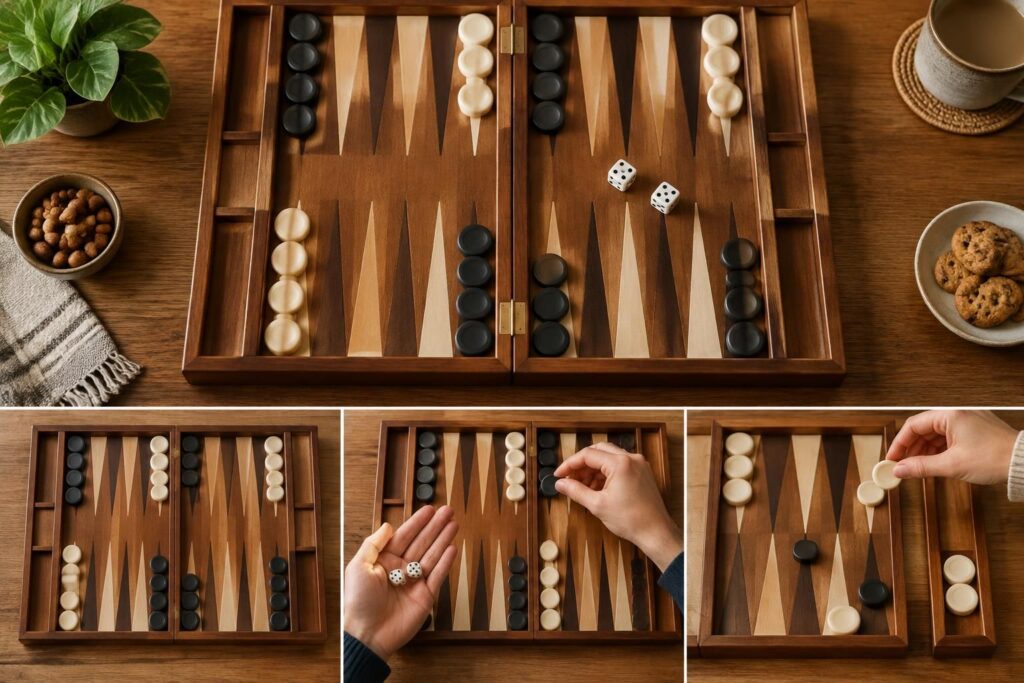
Backgammon is discovered around a game board, with fifteen checkers per person and two dice. The principle seems simple: to advance your checkers according to the results obtained, gather them in your home board, then bear them off before your opponent. But between moves, hits, and tactical choices, each roll opens several possibilities. For beginners, the most reassuring thing is to learn the backgammon rules in order, without trying to master everything from the first game.
Imagine Lou and Sami, who are setting up their board game for the first time. They start by identifying the twenty-four points on the board, then follow the path of their checkers in the agreed direction. Very quickly, they understand that a die does not just dictate a move: it invites choosing between moving cautiously, protecting oneself, or attempting a hit. A game then becomes a small exercise in thinking, with an element of chance and a lot of anticipation.
The essential steps are easy to remember: set up the game, roll the dice, make the allowed moves, manage hit checkers, then organize their bearing off. The first games can be slow, and that is perfectly normal. With some visual markers and decisions explained aloud, backgammon becomes an accessible, lively, and pleasant game to share.
In brief: backgammon rules to remember
- The goal: bring your fifteen checkers into your home board, then bear them off before your opponent.
- The dice: each result indicates a separate move; a double allows playing four times the displayed value.
- The moves: a checker can move onto a free point, one occupied by its own checkers, or one occupied by a single opposing checker.
- The hit: a lone opposing checker can be hit and placed on the bar; it must re-enter before any other move.
- The bearing off: it begins once all fifteen checkers are in the home board.
A game is played by two players and mixes strategy and chance: to better understand this combination, discover also these games where chance meets thinking.
Setting up the game board and understanding the path
The board features twenty-four points, represented by elongated triangles, divided into four areas. Each player has fifteen checkers of one color and moves them in the opposite direction to their opponent: it is useful to clearly define this path before starting.
The starting layout is symmetrical. For each player, the checkers are placed as follows: two on their farthest point, five on an intermediate point on the opposite side, three near their home board, and five inside it. If this setup seems hard to memorize, a little trick is to compare the two sides: the positions correspond like in a mirror.
Lou and Sami check their rows together before the first roll. This ritual prevents starting with a misplaced checker and helps identify areas where opponents may meet. Once the path is understood, the first roll can decide who starts: each rolls a die, and the highest result plays first with both values obtained; in case of a tie, players reroll.
Checker movement: reading the dice and choosing your moves
On their turn, a player rolls two dice. Each number corresponds to a separate move: with a 3 and a 5, they can move one checker three points then another five, or move the same checker three then five if each step is legal. The destination must be free, occupied by their own checkers, or protected by at least two opposing checkers.
A point occupied by a single opposing checker is called a blot: it can be hit. Conversely, a point occupied by two or more opposing checkers is closed, and no checker can land there. If only one of the two dice can be played, this value must be used; when both can be played separately but not both together, the higher value must be played.
A double changes the pace: a 4 and 4 result allows four moves of four points, as long as each is legal. Before moving, Lou spots closed points and isolated checkers; this brief observation time helps avoid impulsive moves. To review the rules step by step, a guide to mastering backgammon can complement this initial introduction.
Hitting checkers: what to do when a checker is hit?
When a player ends their move on a point occupied by a single opposing checker, that checker is hit and placed on the bar, the central divider of the board. Hitting checkers may seem harsh at first, but it is part of the game: it offers a chance to slow the opponent while forcing them to re-enter their checkers.
A checker on the bar must re-enter the opponent’s home board before its owner can move any other checkers. The die number indicates the corresponding entry point; if this point is closed by two or more opposing checkers, entry is impossible with that value. If neither value allows re-entry, the turn is lost.
Sami hits an isolated checker of Lou, who then waits for an opening to bring it back in. This situation reminds us that a lone checker is vulnerable: gathering several on the same point can form a protection, even if sometimes it limits movement options. The good habit is to check the safety of checkers before seeking a spectacular hit.
Bearing off: finishing the game without rushing
Bearing off begins only when all fifteen checkers of a player are in their home board, meaning the last six points of their path. The dice are then used to remove checkers from the board: an exact result allows bearing off a checker positioned on the corresponding point.
If no checker is on the indicated point, a player can sometimes bear off a checker from the highest occupied point, provided there is no checker further back in their home board. For example, with a 6, if points 6, 5, 4, 3, and 2 are empty, a checker on point 1 can be borne off. If a checker is hit during this phase, it must first be re-entered and brought back into the home board before bearing off can resume.
At this stage, Lou and Sami evaluate their farthest and most exposed checkers. Moving everyone toward bearing off without protection can give the opponent a chance to hit a checker; sometimes, consolidating a position is wiser than gaining a single move. To discover variants and boards suited to playing preferences, also explore these ideas around playing on a larger board.
Common beginner mistakes in backgammon
Initial hesitations often arise from very precise rules: a point occupied by a single opponent remains accessible, a closed point is not, and both dice are played as two separate steps. Taking time to check each destination makes the moves clearer and avoids backtracking.
Before confirming a move, beginners can follow these four simple steps:
- Identify the two rolled values and check if the roll is a double.
- Choose the first move, then verify that the destination point is allowed.
- Calculate the second move from the new position of the checker, if the same checker is used.
- Check for isolated checkers and the possible presence of a checker on the bar before passing the turn.
This routine gradually turns the rules into reflexes. A first game doesn’t need to be fast: explaining aloud why a point is open or closed helps everyone better understand the game’s logic.
Helpful questions about backgammon rules
How many checkers does each player use in backgammon?
Each player has fifteen checkers, usually in a different color. They follow opposing paths on the twenty-four points of the board.
Can a checker be moved to a point occupied by the opponent?
Yes, if there is only one opposing checker there: it is then hit and placed on the bar. A point occupied by at least two opposing checkers is closed.
What does getting a double on the dice mean?
A double allows playing four moves corresponding to the displayed value, provided each move is legal.
When can bearing off checkers start?
You must first have gathered your fifteen checkers in your home board. Then you can bear them off based on the dice results, respecting the bearing off rules.


